
The Hand Grinder Bible: Everything You Need to Know
Table of Contents
- The Evolution of Manual Coffee Grinding
- Why Manual Grinders Beat Electric for Off-Grid Living
- Understanding Burr Geometry and Materials
- The Best Manual Coffee Grinders for Every Budget
- Dialing In: Mastering the Click System
- Portability and Ergonomics: The Traveler’s Perspective
- Maintenance and Cleaning in Remote Locations
- Common Mistakes When Using a Hand Grinder
- Comparison Table: Top Hand Grinders at a Glance
- Frequently Asked Questions
The Evolution of Manual Coffee Grinding
For decades, the hand grinder was seen as a relic of the past or a cheap compromise for those who couldn't afford a "real" electric burr grinder. Most early manual models featured ceramic burrs that produced inconsistent particle sizes and required a significant amount of elbow grease to process even a single dose of coffee. However, the last ten years have seen a massive technological leap in the world of manual coffee preparation. Modern hand grinders are now precision-engineered instruments, often outperforming electric grinders that cost three or four times as much. This evolution has been driven by a growing community of "nomad" brewers—travelers, van-lifers, and off-grid enthusiasts—who demand cafe-quality coffee without the need for a power outlet.
The shift toward high-end manual grinding is primarily centered around the move from ceramic to stainless steel burrs and the implementation of dual-bearing shafts. In the past, the "wobble" of the center shaft in cheap grinders led to a mix of fine dust and large boulders in the coffee bed, resulting in a brew that was simultaneously bitter and sour. Today’s best manual coffee grinders utilize ball bearings to keep the shaft perfectly centered, ensuring that every coffee bean is cut with surgical precision. This level of consistency was once exclusive to industrial-grade equipment but is now available in a package that fits inside your backpack.
For the off-grid brewer, this evolution means that the quality of your morning cup no longer depends on your proximity to a power grid. Whether you are perched on a mountain ridge or parked in a remote desert, a high-quality hand grinder provides the tactile satisfaction of the "slow coffee" movement while delivering a grind profile that rivals the best shops in Seattle or Melbourne. It is no longer a compromise; for many enthusiasts, manual grinding is the preferred method because it offers a level of control and "feel" that an electric motor simply cannot replicate.
Why Manual Grinders Beat Electric for Off-Grid Living
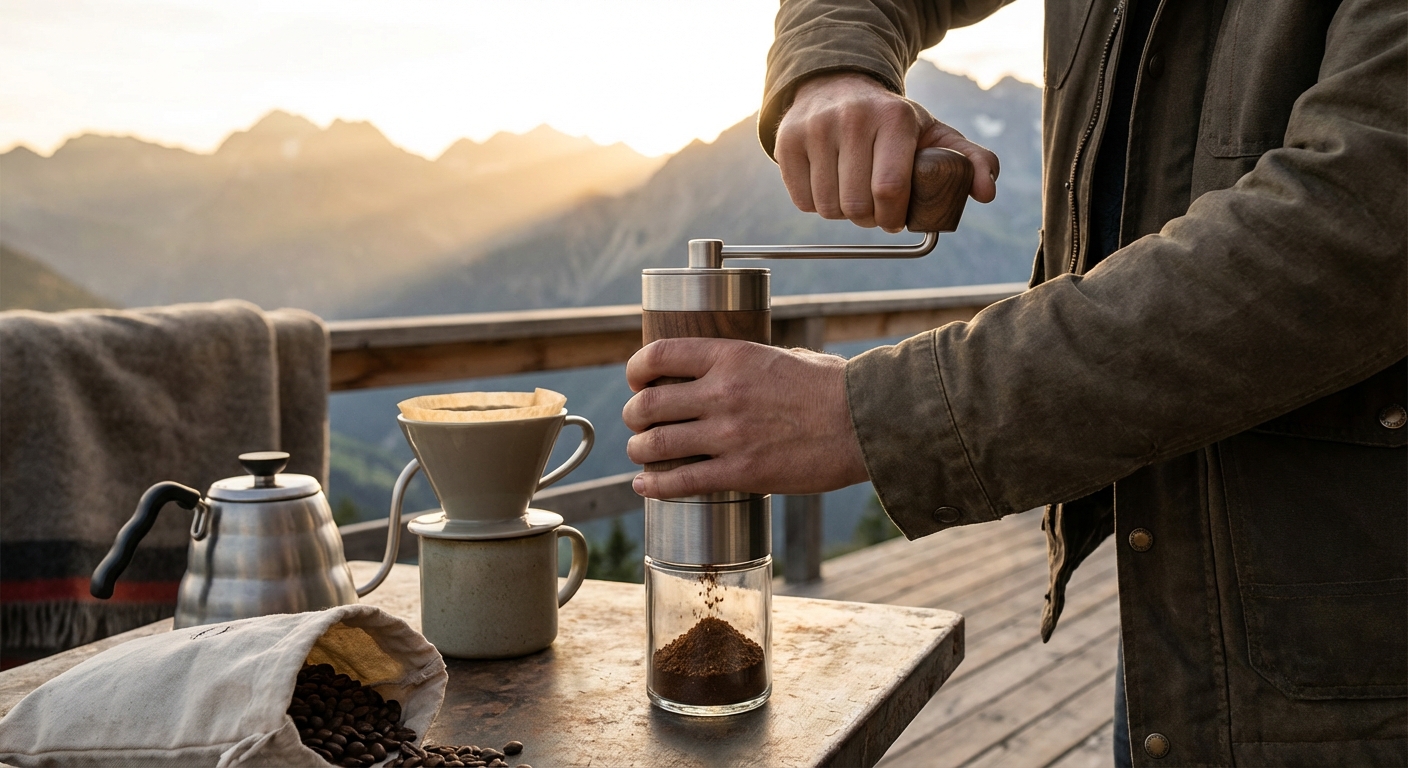
The most obvious advantage of a manual grinder for the nomad is the lack of a power requirement. In a van or an off-grid cabin, every watt of electricity is precious, usually harvested from solar panels or stored in limited battery banks. Running a high-wattage electric grinder can put an unnecessary strain on your system, especially on cloudy days. A manual grinder relies entirely on human kinetic energy, making it the most sustainable and reliable option for those living away from the traditional grid. It removes a point of failure from your morning routine; as long as you can move your arm, you can have fresh coffee.
Beyond power consumption, noise is a significant factor that many overlook until they are in a small, shared space like a campervan or a quiet campsite. Electric grinders are notoriously loud, often reaching decibel levels that can wake up everyone in a 50-foot radius. Manual grinders, by contrast, operate at a much lower frequency and volume. The sound of high-carbon steel burrs slicing through beans is a rhythmic, satisfying crunch that enhances the morning ritual rather than disrupting the peace of the wilderness. This "stealth grinding" is a major quality-of-life improvement for those who value the tranquility of their surroundings.
Finally, manual grinders offer superior grind quality per dollar spent. When you buy an electric grinder, a significant portion of the price goes toward the motor, the casing, the wiring, and the electronics. With a manual grinder, nearly 100% of your investment goes into the quality of the burrs and the precision of the internal alignment. This means that a $200 hand grinder will almost always produce a more uniform grind than a $200 electric grinder. For the nomad who wants the best possible flavor from their beans, the manual route is the most efficient way to achieve professional-grade results without the bulk and baggage of a motorized unit.
Understanding Burr Geometry and Materials
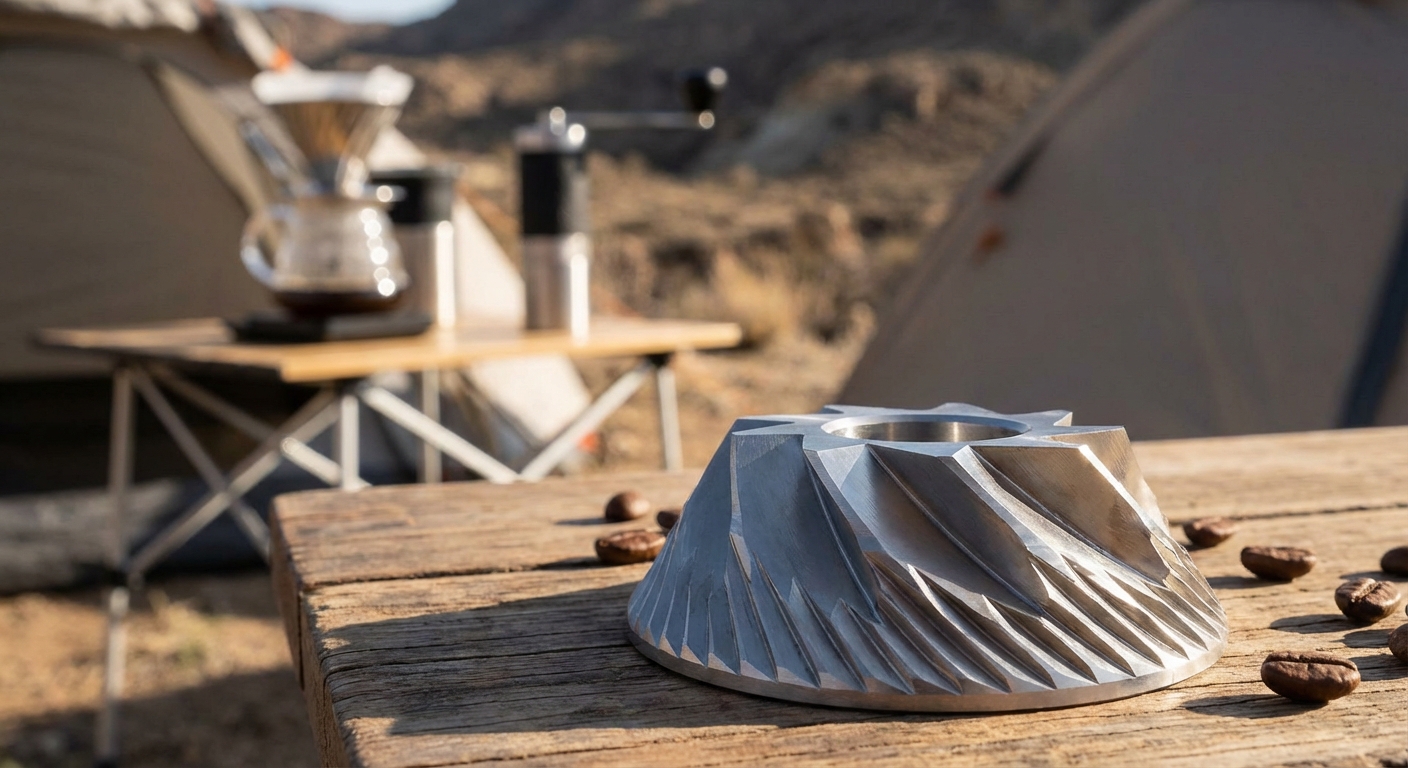
When diving into the world of the best manual coffee grinders, the most critical component to understand is the burr set. Most manual grinders use conical burrs, where a cone-shaped inner burr rotates against a stationary outer ring. The geometry of these burrs—the number of "teeth," their angle, and their sharpness—determines how the coffee is crushed and sliced. High-end grinders often feature specialized burr geometries designed for specific tasks. For example, some burrs are optimized for "fines" production to create the pressure needed for espresso, while others are designed to produce a "clean" profile with minimal fines, perfect for pour-over methods like the V60 or Chemex.
Stainless Steel vs. Ceramic Burrs
Stainless steel burrs are the gold standard for modern manual grinders. They are incredibly sharp, allowing them to slice through coffee beans rather than crushing them. This slicing action results in much higher grind consistency and significantly faster grinding times. A high-quality steel burr can grind 20 grams of coffee in 30-45 seconds, whereas a ceramic burr might take two minutes of strenuous effort. Steel is also more durable against impacts, though it can dull over many years of heavy use. For the traveler, the speed and clarity of flavor provided by steel are worth the higher price point.
Ceramic burrs, on the other hand, are often found in entry-level grinders. They are prized for being rust-proof and for not generating heat during the grinding process (though heat is rarely an issue in manual grinding anyway). The downside is that ceramic is brittle; if a small stone accidentally makes its way into your beans, it can chip or shatter a ceramic burr. Furthermore, ceramic burrs are rarely as sharp as steel, leading to a more "shattered" grind profile with more dust, which can make your coffee taste muddy. At NomadBrew, we generally recommend steel burrs for anyone serious about their off-grid coffee experience.
The Best Manual Coffee Grinders for Every Budget
Selecting the right grinder depends on your primary brewing method and your budget. In this section, we highlight the industry leaders that have proven their worth in the field.
{{PRODUCT_CARD:B09C1B8N99}}
The 1Zpresso K-Ultra is widely considered one of the best manual coffee grinders currently on the market for those who want a "do-it-all" solution. We recommend this grinder because of its external adjustment ring, which makes switching between espresso and coarse French press settings incredibly intuitive. Instead of taking the grinder apart to click a wheel at the bottom, you simply twist the collar on the outside, similar to a high-end camera lens.
This grinder is best for the "prosumer" nomad who switches brew methods frequently. If you make a pour-over in the morning and an Aeropress in the afternoon, the K-Ultra’s ease of use is unmatched. The 48mm stainless steel burrs are aggressive and fast, handling light roast beans with ease. The standout feature is the foldable handle, which makes it significantly more packable for travel. The only real drawback is the price; it is a premium investment. However, compared to electric alternatives like the Fellow Ode, it offers more versatility and better portability for the off-grid user.
{{/PRODUCT_CARD}}
{{PRODUCT_CARD:B083L9Z76H}}
The Comandante C40 MK4 is the legendary "gold standard" of the manual grinding world. It is recommended for those who prioritize flavor clarity above all else. The "Nitro Blade" burrs are the result of years of research into metallurgy, designed to be incredibly tough and chemically neutral. This grinder is best for the dedicated pour-over enthusiast who wants to extract every subtle note of blueberry or jasmine from a high-quality light roast.
The standout feature of the C40 is its community support; almost every world-class coffee recipe online includes a "Comandante click" reference, making it easy to follow professional guides. It is also built like a tank, using high-quality wood veneers and reinforced polymers. The main drawback is the adjustment system, which is located internally and lacks the numbered convenience of the 1Zpresso models. It also uses a 100% plastic internal support frame which, while durable, doesn't feel quite as "premium" as all-metal competitors. Despite this, its grind consistency remains the benchmark for the industry.
{{/PRODUCT_CARD}}
{{PRODUCT_CARD:B09WDRW689}}
For the budget-conscious traveler or someone just starting their off-grid journey, the Timemore Chestnut C3 is an incredible value. We recommend it because it brings "S2C" (Spike to Cut) burr technology down to an entry-level price point. This technology pre-cuts the beans before they enter the main grinding zone, which increases consistency and reduces the effort required to turn the handle.
This grinder is best for the backpacker or the occasional camper who wants a significant upgrade over a blade grinder or a cheap ceramic model without spending $200. It is lightweight, features a textured grip that is easy to hold even in cold weather, and is slim enough to fit inside the plunger of an Aeropress. The drawback is the capacity; it generally only holds about 20-25 grams of coffee, which might be limiting if you are brewing for two. Additionally, it is not ideal for espresso, as the adjustment steps are a bit too large to "fine-tune" the pressure perfectly.
{{/PRODUCT_CARD}}
Dialing In: Mastering the Click System
Most of the best manual coffee grinders use a "click" system for adjustment. Since there is no digital screen or sliding scale, you must calibrate the grinder by turning the adjustment nut all the way to the "zero" point (where the burrs are fully closed) and then counting the "clicks" as you open them. Understanding this system is vital for off-grid brewing because you don't have the luxury of wasting beans on multiple failed test shots when your supply is limited. Generally, a lower number of clicks results in a finer grind (espresso), while a higher number results in a coarser grind (French Press or Cold Brew).
For a standard pour-over, most grinders will land somewhere in the middle of their range. For example, on a Timemore C3, you might start at 13 clicks, while on a Comandante, you might start at 22. It is important to keep a "grind log" in your travel kit. Because changes in altitude and humidity (common in nomadic life) can affect how coffee beans behave, having a baseline reference allows you to make small, calculated adjustments. If your brew is taking too long to drain and tastes bitter, move 1-2 clicks coarser. If it drains too fast and tastes sour, move 1-2 clicks finer.
Precision is the name of the game. The difference between a "good" cup and a "great" cup often comes down to just two clicks. High-end grinders like the 1Zpresso J-Max offer clicks as small as 8.8 microns, allowing for "micro-adjustments" that are essential for dialing in espresso. For the off-grid brewer using an Aeropress or a Clever Dripper, such extreme precision isn't always necessary, but having a grinder that is "stepped" (meaning it clicks into place) is much better than "stepless" for travel, as it won't accidentally shift settings while bouncing around in a backpack.
Portability and Ergonomics: The Traveler’s Perspective
When you are living out of a bag or a small vehicle, every inch of space matters. This is where the ergonomics and physical design of a hand grinder become just as important as the grind quality. A grinder with a long, fixed handle can be a nightmare to pack, often poking holes in gear or requiring its own dedicated case. Look for grinders with removable or foldable handles. Some modern designs even feature magnetic handle attachments, which allow for quick assembly and disassembly. The "footprint" of the grinder should ideally be slim enough to be gripped comfortably by a wide range of hand sizes, as grinding light-roast beans can require a fair amount of torque.
Weight is another crucial factor for the off-grid enthusiast. While a heavy, solid-steel grinder feels premium, it might not be the best choice for a multi-day thru-hike. Aluminum-bodied grinders offer a great middle ground, providing structural integrity and a "heft" that feels quality without adding unnecessary pounds to your pack. Some ultra-portable models, like the Porlex Mini, are designed specifically to fit inside the body of an Aeropress, creating the ultimate compact travel coffee kit. This "nesting" capability is a game-changer for minimalist travelers.
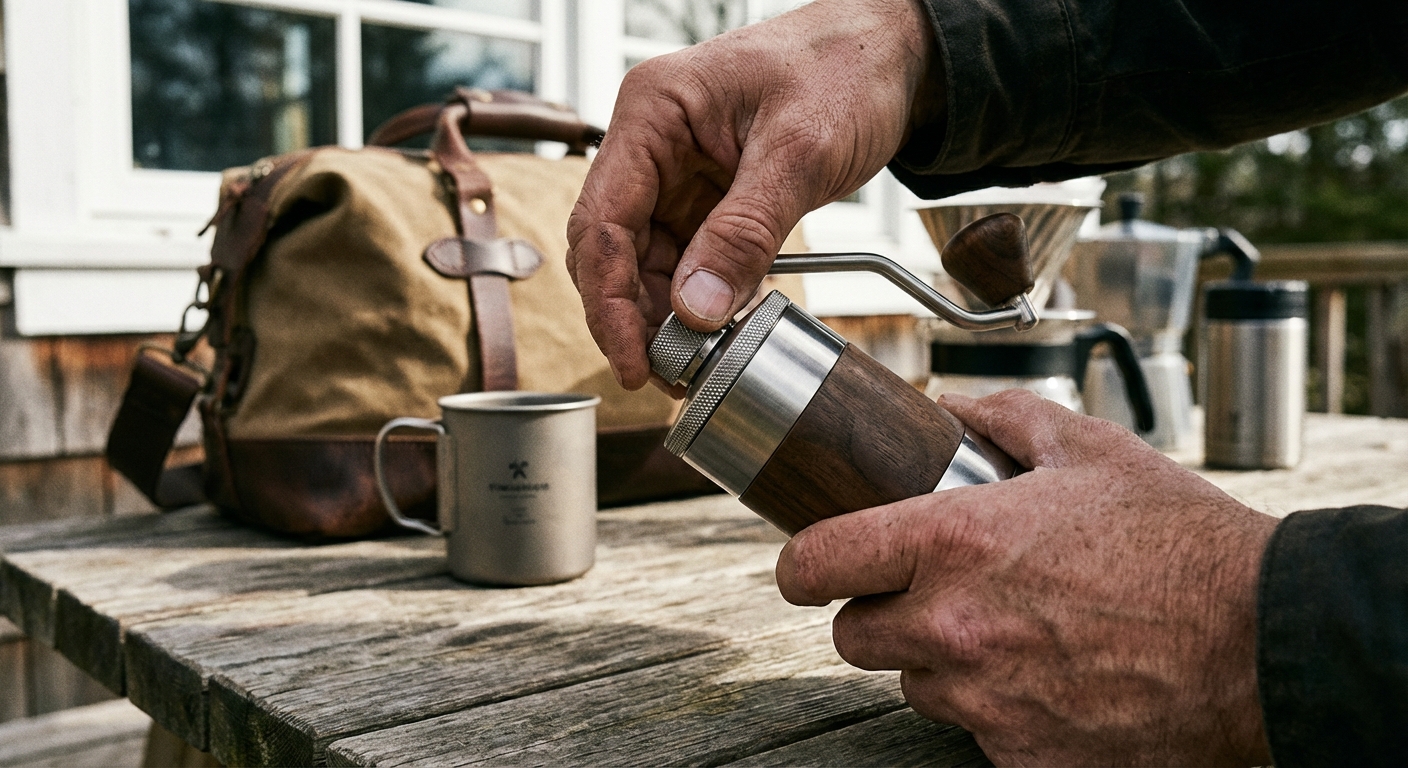
Ergonomics also extend to the "grip" of the grinder. When you are grinding in the cold morning air, a smooth metal surface can be slippery and difficult to hold. Many of the best manual coffee grinders now feature knurled textures or silicone bands to ensure a secure grip. The shape of the "pommel" (the knob at the end of the handle) also matters; a larger, rounder pommel that fits in the palm of your hand allows you to use your shoulder and chest muscles to grind, rather than just your wrist, which prevents fatigue over time.
Maintenance and Cleaning in Remote Locations
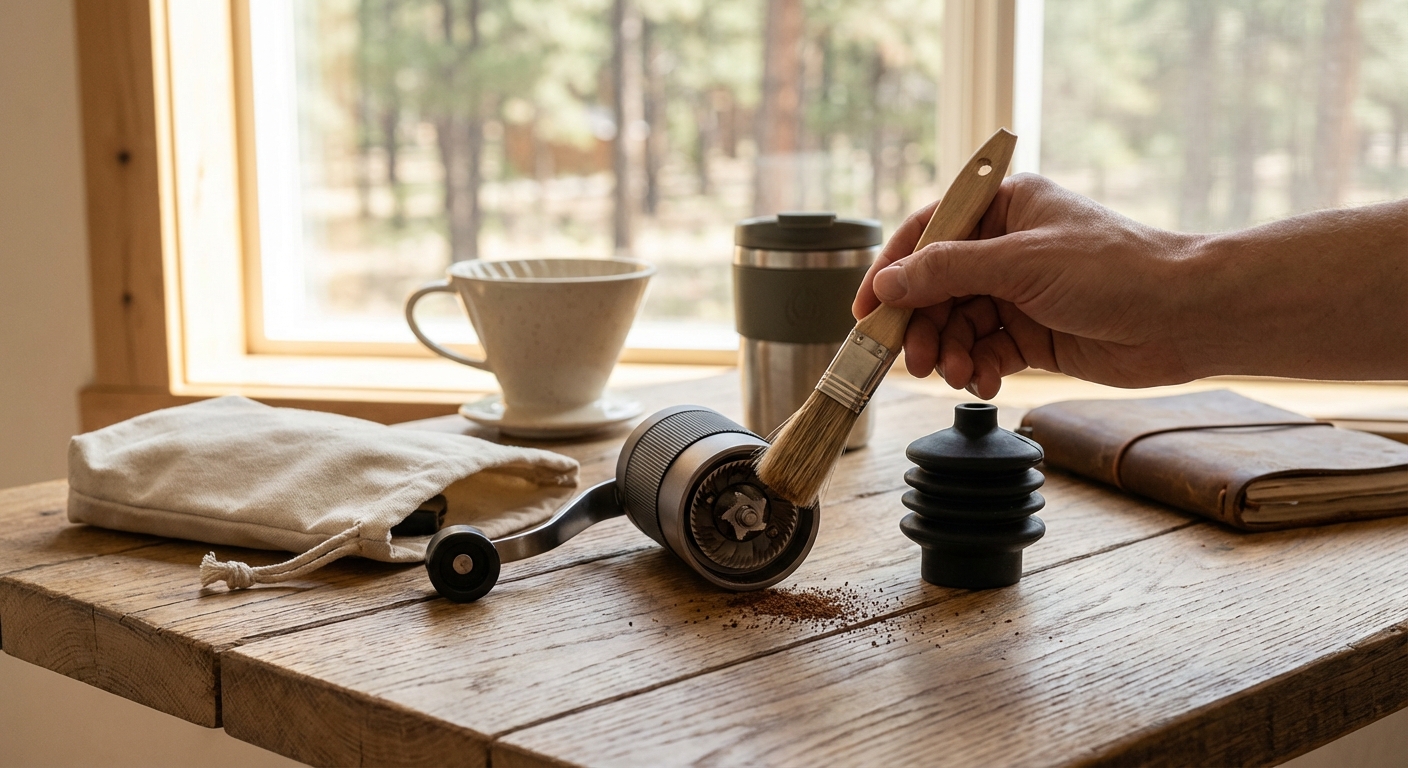
In an off-grid environment, water is often a limited resource, and you certainly don't want to waste it cleaning a coffee grinder. The good news is that you should never use water to clean the internals of a manual grinder, especially if it has steel burrs or ball bearings. Water can lead to rust and can strip away the necessary lubrication in the bearings. Instead, the best way to maintain your grinder in the field is with a simple dry brush and a bellows (air blower). After every few uses, disassemble the catch cup and the outer burr (if the design allows) and brush out the "fines" and silver skin that accumulate in the crevices.
Deep cleaning should be done once a month or whenever you switch between very different types of coffee beans. If you’ve been grinding an oily dark roast and want to switch to a delicate light roast, the residual oils can go rancid and spoil the flavor of your new beans. In a remote setting, you can use "grinder cleaning pellets" (like Urnex Grindz), which are essentially food-safe tablets that you grind through the machine to soak up oils and push out old particles. If you don't have pellets, simply "purging" the grinder by grinding a small gram or two of your new beans and discarding them can help clear out the old residue.
Proper storage is the final piece of the maintenance puzzle. When traveling, ensure the grinder is stored in a dry place. If you are in a high-humidity environment or near the ocean, the salt air can be corrosive. A simple padded sleeve or a dedicated hard case can protect the alignment of the internal shaft from being knocked out of place during transit. A well-maintained hand grinder can easily last a decade or more, making it one of the most sustainable pieces of gear in your off-grid kitchen.
Common Mistakes When Using a Hand Grinder
One of the most frequent mistakes beginners make is "holding the grinder wrong." Many people try to hold the grinder vertically and turn the handle like a crank on a well. This is inefficient and puts strain on the wrist. The "pro" technique is to hold the grinder at a slight angle and move both hands in an elliptical motion—think of it like "pedaling" a bicycle with your hands. This uses both arms to share the load and makes grinding even the hardest light-roast beans much faster and easier.
Another common pitfall is adjusting the grind setting while there are beans stuck in the burrs. If you try to move to a finer setting while a fragment of a bean is wedged between the burrs, you can put unnecessary stress on the adjustment mechanism or even strip the threads. Always ensure the burrs are empty before making significant adjustments, or keep the handle spinning while you turn the adjustment dial to ensure any trapped particles are cleared out. This simple habit will significantly extend the life of your grinder’s internal components.
Finally, many nomads neglect to "zero" their grinder regularly. Over time, the adjustment nut can slightly shift due to vibrations during travel. If you notice your brew times are drifting even though you haven't changed your "clicks," it’s time to reset. Turn the dial all the way to the closed position to confirm where "zero" actually is, then count back out to your desired setting. This ensures that your 20-click setting today is the exact same as your 20-click setting from a month ago, maintaining that crucial consistency that makes manual brewing so rewarding.
Comparison Table: Top Hand Grinders at a Glance
| Product Name | Best For | Burr Material | Weight | Approx. Price |
|---|---|---|---|---|
| 1Zpresso K-Ultra | All-Rounder / Espresso | Stainless Steel | 700g | $250 |
| Comandante C40 MK4 | Flavor Clarity / Pour-Over | Nitro-Steel | 740g | $320 |
| Timemore Chestnut C3 | Budget / Backpacking | S2C Steel | 430g | $70 |
| 1Zpresso J-Max | Pure Espresso | Coated Steel | 775g | $200 |
| Porlex Mini II | Ultra-Minimalism | Ceramic | 230g | $65 |
Frequently Asked Questions
Can I use a cordless drill to power my hand grinder? While it is technically possible and many people do it, we generally advise against it unless the grinder is specifically designed for it. Most hand grinders use a hexagonal shaft that fits a standard drill bit, but the high RPM (revolutions per minute) of a power drill can generate heat that the burrs weren't designed to handle. More importantly, the torque from a drill can put immense stress on the internal plastic supports and bearings, potentially snapping them or knocking the burrs out of alignment. If you are truly in a rush, use a low speed, but part of the charm of the best manual coffee grinders is the manual process itself.
How long does it take to grind for a standard cup of coffee? The time depends heavily on the quality of the burrs and the roast level of the beans. With a high-end steel burr grinder like the 1Zpresso K-Ultra, you can grind 20 grams of coffee for a pour-over in about 30 to 40 seconds. For espresso, which is much finer, it may take 45 to 60 seconds. Cheaper ceramic grinders will take significantly longer, often requiring 2 to 3 minutes of vigorous cranking for the same amount of coffee. Light roast beans are also denser and harder than dark roasts, meaning they require more physical effort and slightly more time to process.
Why is my hand grinder making a squeaking noise? A squeaking noise usually indicates that the metal-on-metal or metal-on-plastic contact points need a tiny bit of lubrication, or there is a build-up of coffee oils and dust in the bearings. First, try a deep clean with a brush. If the squeak persists, check the handle attachment point and the main shaft. You can use a tiny drop of food-grade mineral oil on the moving parts (avoiding the burrs themselves). However, in many cases, a squeak is simply a sign that a screw has loosened during travel; ensure everything is tightened according to the manufacturer's specifications.
Are manual grinders actually better than electric ones? In terms of "grind quality per dollar," yes. A $200 manual grinder will almost always produce a more uniform grind than a $200 electric grinder because the manufacturer doesn't have to spend money on a motor and electronics. For off-grid and travel use, they are objectively better because they are portable, silent, and don't require electricity. However, if you are brewing for a large group of six people every morning, the physical labor of a manual grinder can become a chore. For the solo traveler or couple, the manual grinder is the superior choice for flavor and reliability.
How do I know when my burrs need to be replaced? For the average home user or nomad, stainless steel burrs will last for 500 to 1,000 pounds of coffee. If you grind 30 grams a day, that’s roughly 15 to 20 years of use. You’ll know they are getting dull if the grinding process starts taking significantly longer than it used to, or if the "clarity" of your coffee disappears, replaced by a muddy, inconsistent taste. Ceramic burrs don't really "dull" in the same way, but they are prone to micro-chipping, which will eventually degrade the grind quality. Most high-end brands sell replacement burr sets, so you don't have to buy a whole new grinder.
Does the static build-up in hand grinders go away? Static is a common issue with all grinders, causing coffee grounds to cling to the catch cup and the bottom of the burrs. This is often worse in dry, high-altitude environments—exactly where many nomads find themselves. A simple trick to eliminate static is the "Ross Droplet Technique" (RDT). Simply dip the end of a spoon (or your finger) in a bit of water and stir it into your beans before grinding. This tiny amount of moisture neutralizes the static charge, allowing the grounds to fall cleanly into the cup.
Can I grind spices in my coffee grinder? We strongly recommend against this. Coffee beans are porous and easily absorb odors and flavors. If you grind black pepper or cumin in your manual grinder, those oils will permeate the burrs and the internal housing, tainting every cup of coffee you make for weeks or even months. If you need a spice grinder for your off-grid kitchen, it is much better to buy a dedicated, cheap ceramic hand grinder specifically for that purpose and keep your coffee equipment pristine.
Our Top Picks for 2026
We've spent hours researching and testing to find the absolute best options currently available.

JoCaffè Manual Coffee Grinder for Home Use, Stainless Steel Conical Burr, Espresso Bean Coffee-Grinder, Best Small Portable Mill, Adjustable Grind Settings, Mini Hand Crank, Moledor de Cafe de Grano Silver
- Superior Grinding Mechanism: Precision-engineered manual coffee grinder designed to deliver consistent and uniform coffee grounds
- Adjustable Settings: Multiple grind size settings allow you to customize your coffee from fine espresso to coarse French press
- Compact Design: Portable and lightweight construction makes it convenient for home use, office, or travel

【Famous KOL Recommended】KINGrinder K6 Manual Hand Coffee Grinder with Straight Handle for French Press, Drip, Espresso with Assembly Consistency Stainless Steel Conical Burr Mill, 25-35g Capacity
- [Precise Adjustment]16 um per click. The interior adjustment design of the Kingrinder grinder allows you to set the grind from fine to coarse. There are 60 clicks in a single round with the interior number. A functional grinder could grind to several brew methods.
- [Full Metal Design]Robust design built to last and the stainless steel burr set design. The aluminum material of the body grinder is more durable. The burr set design and the dual bearing design allow you for a better consistent grinding experience.
- [Portable and friendly cleaning]The best travel companions for indoor and outdoor activities - camping and hiking. The hopper volume of the grinder is 25-35g. You could dismantle the grinder with your bare hands and clean it with a brush.

TIMEMORE Chestnut C3S Pro Manual Coffee Grinder, Stainless Steel S2C Conical Burr Coffee Grinder, Hand Coffee Grinder with Foldable Handle, Adjustable Grind Setting for Travel/Camping/Home, Black C3S Pro Black
- [ C3 Pro Upgraded to C3S Pro Full Metal Aluminum Body ] Crafted with an all-metal aluminum alloy body, the TIMEMORE C3S Pro manual coffee grinder offers outstanding durability and longevity. This sturdy construction not only withstands frequent use but also protects the internal components from any potential damage. Additionally, the aluminum alloy body contributes to efficient heat dissipation during grinding sessions, preventing overheating that can compromise the delicate flavors of your coffee beans.
- [ S2C Patent Hexagonal Conical Grinding Burr ] The TIMEMORE Manual Coffee Grinder is equipped with the revolutionary S2C660 patent conical burr. Hand Coffee Grinder Milling blade with 55-58HRC hardness in 5-axis CNC machining realizes uniform grinding with almost no excessively coarse grains. At the same time, the generation of fine powder is minimized. This advanced burr design ensures a consistent and even grind size, allowing for the perfect extraction of flavor from every bean
- [ Foldable Crank Handle ] The foldable crank handle on the coffee bean grinder presents both practicality and portability benefits for users on-the-go or those looking to save storage space at home or during travel
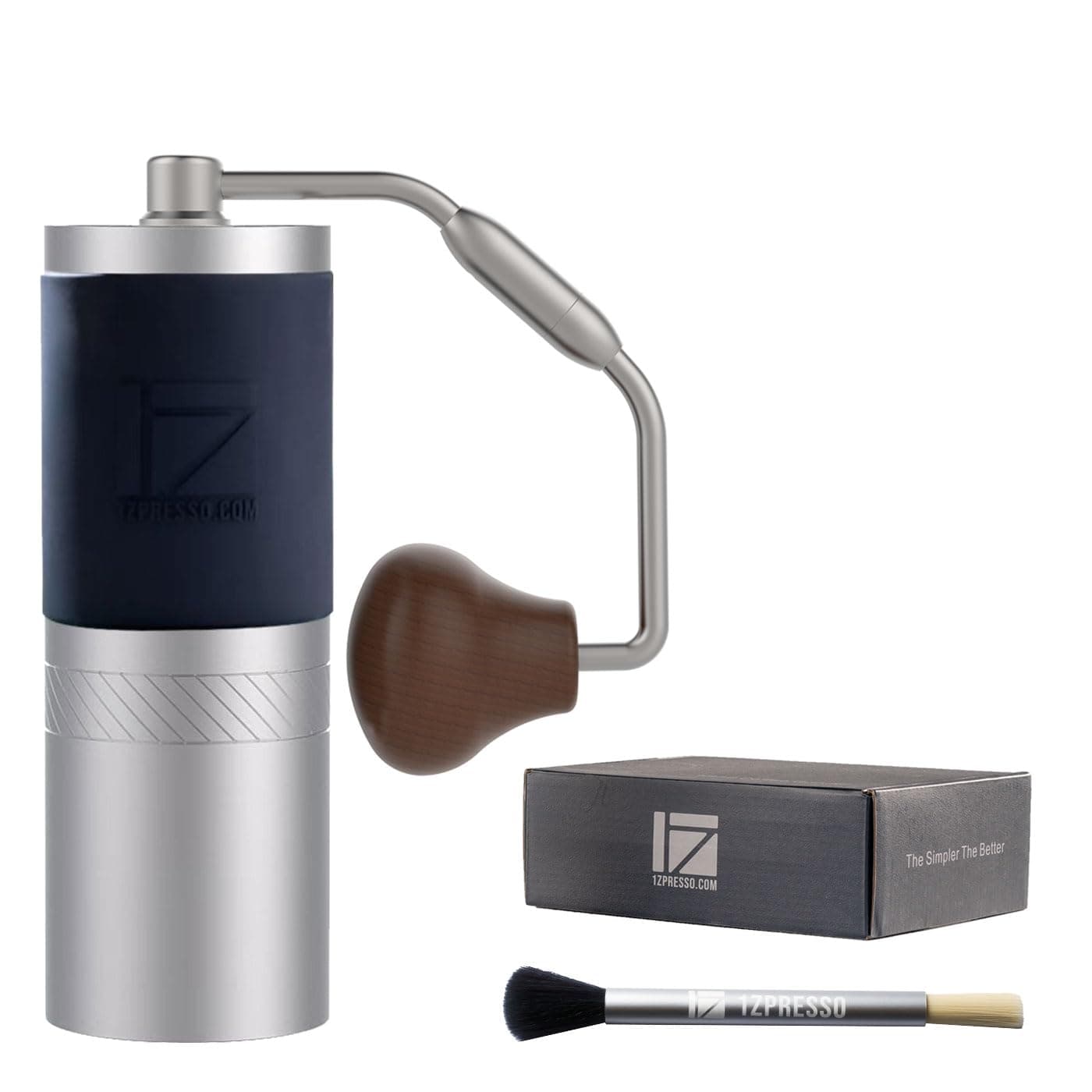
1Zpresso J Manual Coffee Grinder Silver Capacity 35g with Assembly Stainless Steel Conical Burr - Numerical Internal Adjustable Setting J Silver
- Foldable Handle - Solid and foldable crank handle for portability and space-saving convenience. Compact design makes it easy to carry and store.
- Looking for quality but budget grinder? 1Zpresso J grinder worth it!! Durable 48mm conical burr makes greater grinding efficiency. Internal fixing between the burr and central shaft, impressive consistency grind.
- Internal Adjustment- with 30 clicks each rotation enables you to find the right size setting for your favorite flavor.
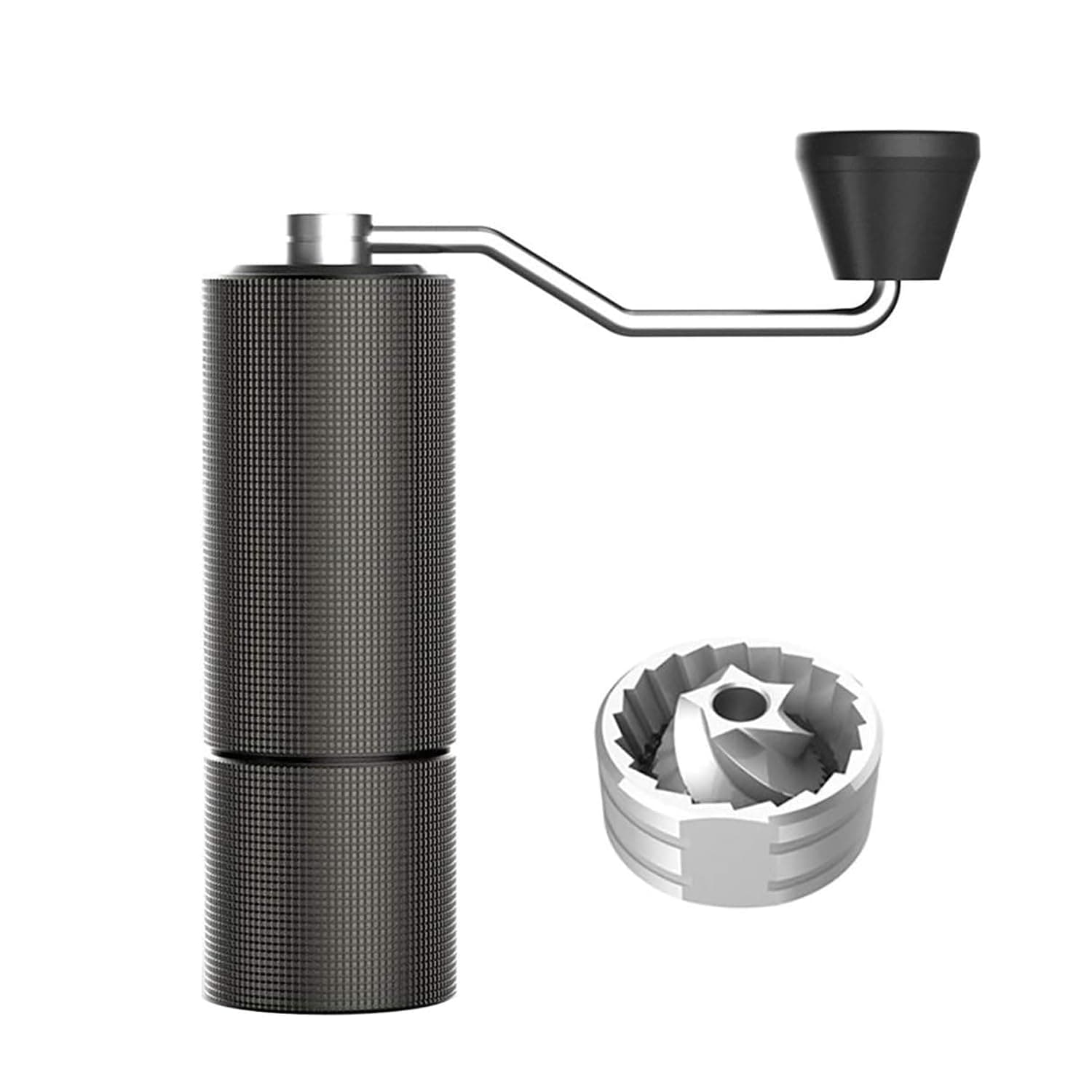
TIMEMORE Chestnut C2 Manual Coffee Grinder Capacity 25g with CNC Stainless Steel Tapered Burr - Internal Adjustable Setting, Double Bearing Positioning, French Press Coffee for Hand Grinder Gift C2 Gray
- Metal body 2024 upgraded version,High quality 420 stainless steel burrs: The burrs are formed by cutting high-quality 420 stainless steel through a five axis CNC. The hardness of 55-58HRC can quickly cut coffee beans, and the dual bearing center axis positioning - grinding coffee powder particles evenly, so you can quickly grind a coffee powder that meets the taste.
- Grinding degree adjustment function: built-in grinding degree adjustment knob, simply turn the grinding knob to adjust the manual coffee grinder to obtain the desired coffee taste (clockwise for fine grinding degree, counterclockwise for coarse grinding degree). You can enjoy a wonderful coffee time at home, in the office, or during outdoor camping and hiking, such as pour over coffee ,moka pot coffee , french press coffee,etc.
- Easy to disassemble and clean: The compact design makes it easy to disassemble without the need for any tools. Do not rinse with water, use the complimentary brush to complete the cleaning. In general, it is not recommended to disassemble and replace parts of the bean grinder. This helps improve the accuracy of grinding, and if necessary, please follow the instructions in the manual.
1Zpresso J Manual Coffee Grinder Silver Capacity 35g with Assembly Stainless Steel Conical Burr - Numerical Internal Adjustable Setting J Silver
- Foldable Handle - Solid and foldable crank handle for portability and space-saving convenience. Compact design makes it easy to carry and store.
- Looking for quality but budget grinder? 1Zpresso J grinder worth it!! Durable 48mm conical burr makes greater grinding efficiency. Internal fixing between the burr and central shaft, impressive consistency grind.
- Internal Adjustment- with 30 clicks each rotation enables you to find the right size setting for your favorite flavor.
【Famous KOL Recommended】KINGrinder K6 Manual Hand Coffee Grinder with Straight Handle for French Press, Drip, Espresso with Assembly Consistency Stainless Steel Conical Burr Mill, 25-35g Capacity
- [Precise Adjustment]16 um per click. The interior adjustment design of the Kingrinder grinder allows you to set the grind from fine to coarse. There are 60 clicks in a single round with the interior number. A functional grinder could grind to several brew methods.
- [Full Metal Design]Robust design built to last and the stainless steel burr set design. The aluminum material of the body grinder is more durable. The burr set design and the dual bearing design allow you for a better consistent grinding experience.
- [Portable and friendly cleaning]The best travel companions for indoor and outdoor activities - camping and hiking. The hopper volume of the grinder is 25-35g. You could dismantle the grinder with your bare hands and clean it with a brush.
TIMEMORE Chestnut C3S Pro Manual Coffee Grinder, Stainless Steel S2C Conical Burr Coffee Grinder, Hand Coffee Grinder with Foldable Handle, Adjustable Grind Setting for Travel/Camping/Home, Black C3S Pro Black
- [ C3 Pro Upgraded to C3S Pro Full Metal Aluminum Body ] Crafted with an all-metal aluminum alloy body, the TIMEMORE C3S Pro manual coffee grinder offers outstanding durability and longevity. This sturdy construction not only withstands frequent use but also protects the internal components from any potential damage. Additionally, the aluminum alloy body contributes to efficient heat dissipation during grinding sessions, preventing overheating that can compromise the delicate flavors of your coffee beans.
- [ S2C Patent Hexagonal Conical Grinding Burr ] The TIMEMORE Manual Coffee Grinder is equipped with the revolutionary S2C660 patent conical burr. Hand Coffee Grinder Milling blade with 55-58HRC hardness in 5-axis CNC machining realizes uniform grinding with almost no excessively coarse grains. At the same time, the generation of fine powder is minimized. This advanced burr design ensures a consistent and even grind size, allowing for the perfect extraction of flavor from every bean
- [ Foldable Crank Handle ] The foldable crank handle on the coffee bean grinder presents both practicality and portability benefits for users on-the-go or those looking to save storage space at home or during travel