
Manual Pour Over: The Nomad’s Masterclass
Table of Contents
- Introduction: Why the Pour Over is the Nomad’s Gold Standard
- The Philosophy of Minimalist Brewing
- Choosing Your Vessel: Materials and Portability
- Essential Gear: The Nomad’s Toolkit
- The Technique: Mastering the Pour Anywhere
- Water Management: Sourcing and Heating Off-Grid
- The Grind: Manual Precision on the Move
- Maintenance and Leave-No-Trace Brewing
- Troubleshooting Common Travel Brewing Issues
- Top Product Recommendations
- FAQ: Everything You Need to Know
Introduction: Why the Pour Over is the Nomad’s Gold Standard
For the modern nomad, coffee is more than a morning caffeine hit; it is a ritual that provides a sense of "home" regardless of where the van is parked or where the tent is pitched. While the AeroPress often steals the spotlight for durability, the manual pour over remains the undisputed king for those who value clarity of flavor and a meditative process. Travel pour over coffee allows the subtle notes of a single-origin bean to shine, capturing the bright acidity and floral aromas that immersion methods often mute.
The beauty of the pour over in a travel context lies in its simplicity. At its core, it requires only a filter, a dripper, and hot water. Unlike complex espresso machines or bulky electric brewers, a manual dripper has no moving parts to break and requires no electricity. This makes it the ultimate "off-grid" solution. Whether you are watching the sunrise over the Tetons or sitting in a cramped hostel kitchen in Berlin, the pour over provides a consistent, high-quality experience that connects you to the local culture through the beans you find along the way.
However, mastering travel pour over coffee requires a shift in mindset. You are no longer in a temperature-controlled kitchen with a gooseneck kettle and a digital scale. You are dealing with wind, varying altitudes, and limited water supplies. This masterclass is designed to bridge the gap between the professional barista's counter and the rugged reality of the road, ensuring you never have to compromise on your brew, no matter your coordinates.
The Philosophy of Minimalist Brewing
Minimalism is the cornerstone of the NomadBrew lifestyle. When every cubic inch of your backpack or van conversion matters, your coffee kit must be earned. The philosophy of minimalist pour over brewing is about maximizing "flavor-per-ounce." We look for tools that serve multiple purposes or collapse into nearly nothing. A dripper that can fold flat is superior to a ceramic one that risks shattering on a bumpy forest road.
Beyond physical gear, minimalist brewing is about mastering the variables. In a lab setting, we control everything to the gram and degree. On the road, we learn to "feel" the brew. We learn that 200 degrees Fahrenheit looks like the moment a boil settles into a shimmer. We learn that a medium-fine grind feels like table salt between our fingers. This intuitive connection to the brewing process is what separates a traveler who just drinks coffee from a true nomad barista.
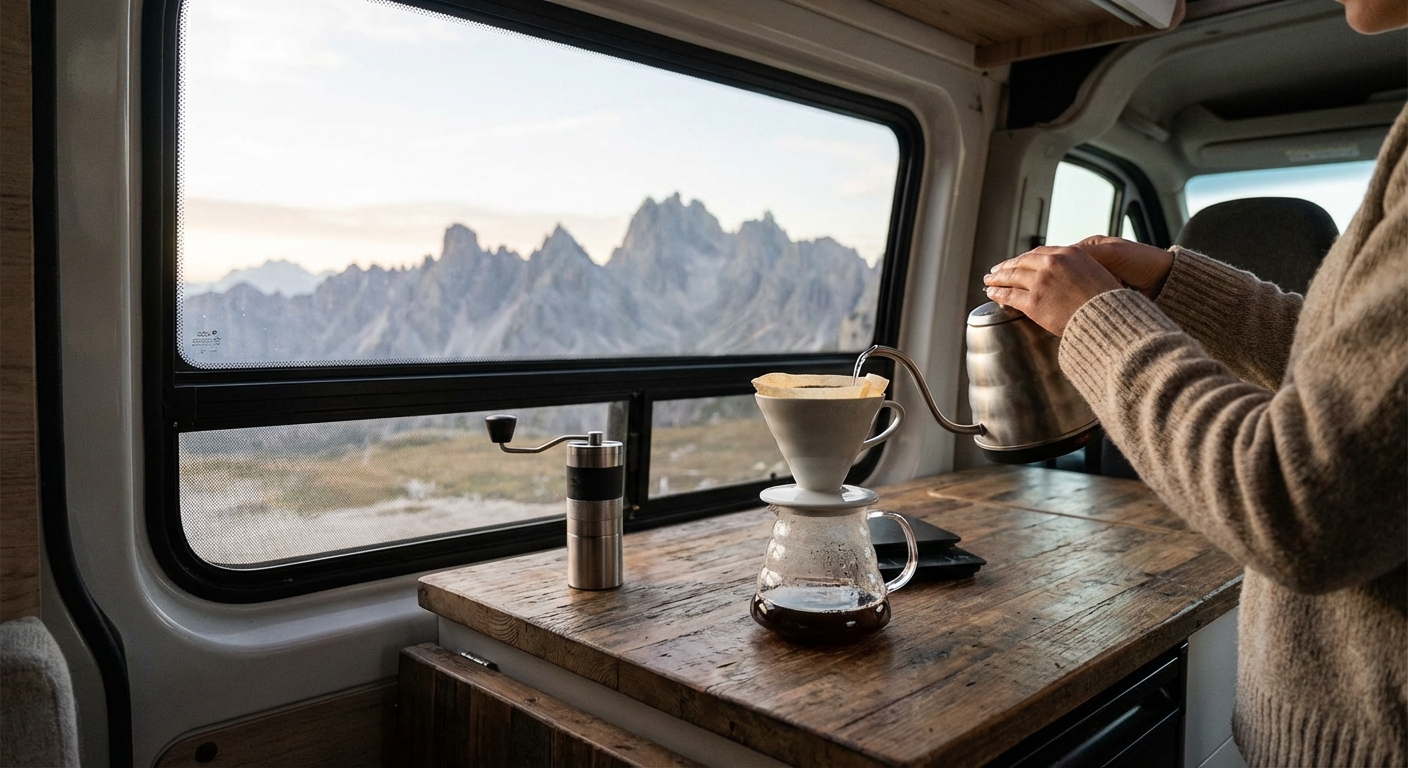
Embracing this philosophy also means accepting the environment. If you are brewing at 10,000 feet, your water will boil at a lower temperature, requiring a finer grind to achieve proper extraction. If it’s a windy morning, your slurry temperature will drop rapidly, necessitating a lid or a more insulated dripper. By understanding the "why" behind extraction, you become adaptable. You stop relying on gadgets and start relying on your senses, which is the most lightweight tool you can carry.
Choosing Your Vessel: Materials and Portability
When selecting a dripper for travel, material choice is your first major decision. Traditionalists love ceramic or glass for their heat retention and aesthetic, but for the nomad, these are liabilities. A single drop onto a rock or a hard galley floor ends your morning ritual. Instead, we look toward high-grade plastics (like BPA-free Tritan), food-grade silicone, or stainless steel. Plastic is surprisingly excellent for brewing because it has low thermal mass; it won't steal heat from your water like a cold ceramic dripper will, leading to a more stable extraction temperature.
Silicone vs. Metal Drippers
Silicone drippers are the darlings of the ultralight backpacking community. They are virtually indestructible and can be squished into the bottom of a pack without a second thought. However, they can sometimes be "fiddly," occasionally collapsing if not seated correctly on a mug. Metal drippers, particularly those made of thin stainless steel or titanium, offer a balance of durability and rigidity. They often come in "flat-pack" designs that snap together, providing a stable platform that feels much more like a professional kitchen tool.
Geometry and Filter Compatibility
The shape of your dripper—conical (like a V60) vs. flat-bottom (like a Kalita)—dictates the flavor profile and the difficulty of the brew. Conical drippers allow for more control but are less forgiving of an uneven pour, which is common when you're using a standard camping pot instead of a gooseneck. Flat-bottom drippers promote a more even extraction, making them ideal for the "rough-and-ready" pours often required in the wild. Always consider filter availability; if you are traveling internationally, standard #2 or #4 cone filters are much easier to find than specialized wave filters.
Essential Gear: The Nomad’s Toolkit
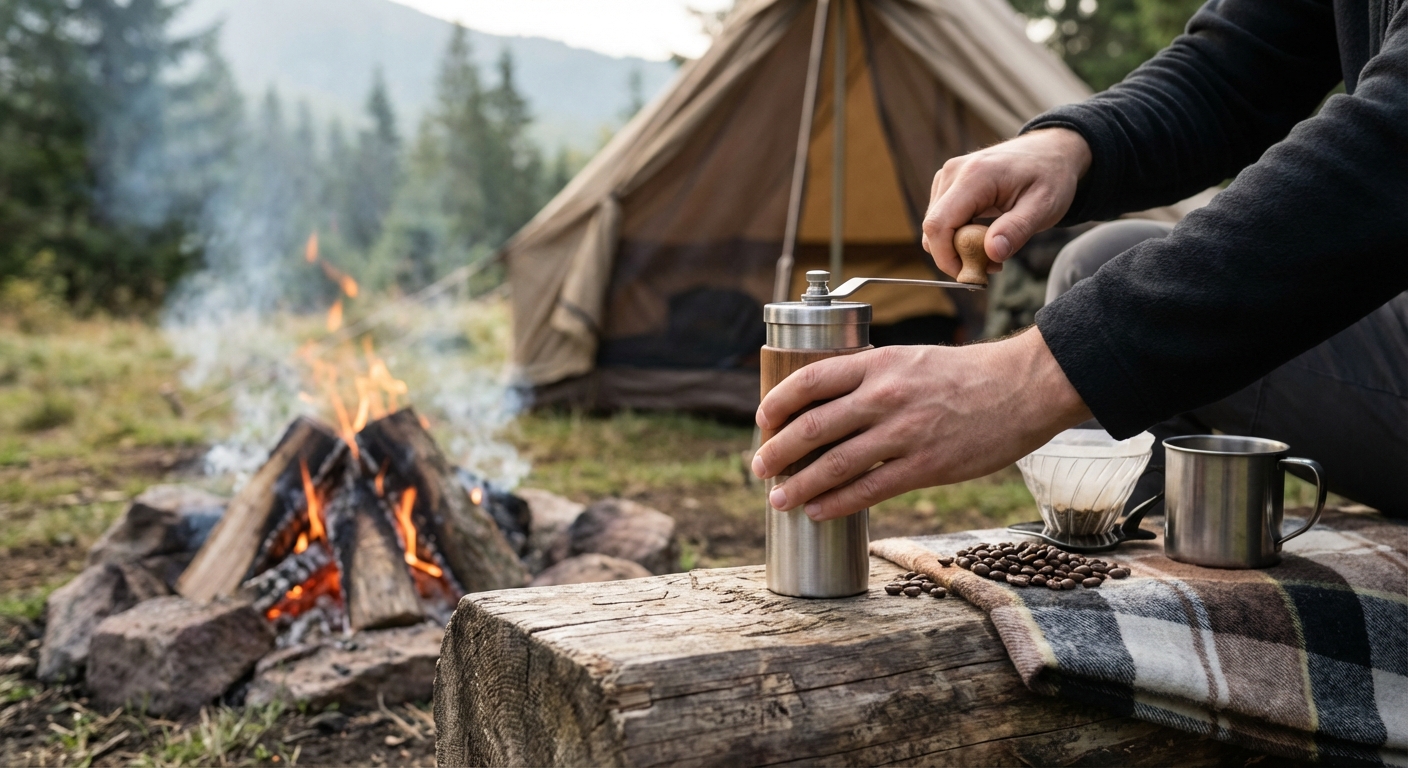
To achieve a masterclass-level pour over on the road, your kit needs a few key components beyond the dripper. First is a reliable manual burr grinder. Blade grinders are useless for pour over, as they produce "fines" that clog the filter and "boulders" that under-extract. A slim, hand-cranked burr grinder fits inside most travel mugs and allows you to adjust your grind size based on the beans you pick up at local roasters. Look for stainless steel or ceramic burrs for longevity.
Next, consider your kettle. While a dedicated gooseneck kettle is the gold standard for precision, they are often too bulky for travel. A "pour-over pitcher" or a small camping pot with a steady pour spout can suffice. Some nomads use a "travel gooseneck," which is a small, lidless stainless steel vessel specifically designed for controlled pouring. If you're truly space-constrained, even a measuring cup with a sharp lip can offer enough control to execute a proper spiral pour.
Finally, don't overlook the importance of a scale. While many purists argue for "eyeballing" it, a small, pocket-sized digital scale (accurate to 0.1g) takes up the space of a smartphone but removes all the guesswork. If a scale is out of the question, use a consistent volumetric measurement—like a specific scoop or a mark on your travel mug—to keep your coffee-to-water ratio as consistent as possible. Consistency is the secret ingredient to a great cup.
The Technique: Mastering the Pour Anywhere
The pour over technique is often treated as a delicate art, but it’s actually a series of logical steps. The first and most critical step is the "bloom." After placing your ground coffee in the filter, pour just enough water (roughly double the weight of the coffee) to saturate the grounds. Wait 30 to 45 seconds. You’ll see the coffee bubble and swell; this is the degassing of carbon dioxide. If you skip this, the gas will repel the water during the main pour, leading to a thin, sour cup.
Once the bloom is complete, begin your main pour. In a travel setting, you likely lack the precision of a gooseneck, so focus on a slow, steady stream in a spiral motion. Avoid pouring directly onto the sides of the filter, as water will bypass the coffee grounds entirely (a phenomenon called "channeling"). Aim for the center and work your way out, keeping the water level consistent. If you are using a flat-bottom dripper, you can be a bit more aggressive with your pour, as the geometry helps regulate the flow.
The total brew time should ideally fall between 2:30 and 3:30 minutes. If your water drains too quickly and the coffee tastes sour, your grind is too coarse. If it takes five minutes and tastes bitter or "ashy," your grind is too fine. Adjusting your manual grinder by just one or two "clicks" can make a world of difference. Remember, in colder outdoor environments, you may want to pour in smaller, more frequent pulses to keep the slurry temperature high, rather than one long, slow pour.
Water Management: Sourcing and Heating Off-Grid
Water is 98% of your coffee, yet it’s the most neglected variable in travel brewing. If you are off-grid, your water source might be a stream, a van tank, or a public tap. Always filter your water for safety, but also for taste. High mineral content (hard water) can make coffee taste dull, while overly soft water can make it taste sharp and salty. A simple portable charcoal filter or a specialized coffee water treatment can drastically improve your results.
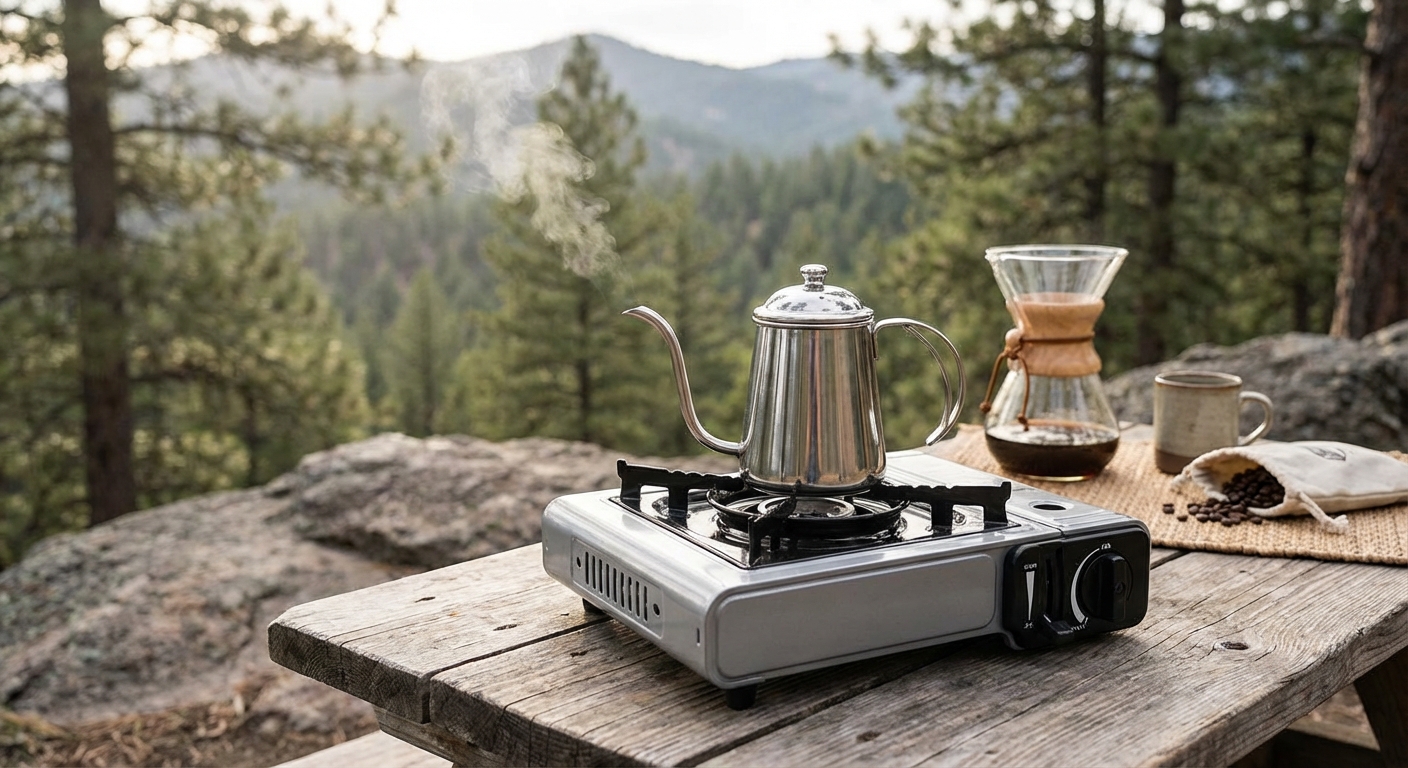
Heating water off-grid usually involves a butane stove, an induction hob, or a campfire. The challenge is temperature control. Coffee extracts best between 195°F and 205°F (90°C-96°C). At sea level, water boils at 212°F. A good rule of thumb is to bring your water to a rolling boil, then remove it from the heat for about 30 to 60 seconds before pouring. This usually lands you right in the "sweet spot" for extraction.
If you are brewing at high altitudes, remember that the boiling point of water drops significantly (e.g., at 10,000 feet, water boils at roughly 193°F). In these cases, you should use the water immediately off the boil. To compensate for the lower temperature, you might need to increase your agitation (stirring the slurry slightly with a spoon) or use a slightly finer grind to ensure you’re pulling enough flavor out of the beans before the water drains through.
The Grind: Manual Precision on the Move
Freshness is the "cheat code" for great coffee. Once coffee is ground, its surface area increases exponentially, leading to rapid oxidation and the loss of those volatile aromatics we love. For the nomad, a manual burr grinder is non-negotiable. Not only does it allow you to grind fresh for every cup, but it also provides a morning workout that feels deeply satisfying in a wilderness setting.
When setting your grind for a travel pour over, aim for the texture of "kosher salt." You want distinct granules, not a fine powder. If you find your hand-grinder is taking too long (more than a minute for 15-20g of coffee), you might be grinding too fine for a standard pour over. Most manual grinders have an adjustment nut under the burrs; tightening it (clockwise) makes the grind finer, while loosening it (counter-clockwise) makes it coarser.
Quality matters here. Cheap manual grinders with ceramic burrs often produce inconsistent results and can be tiring to use. Investing in a grinder with stainless steel burrs and ball bearings will significantly reduce the effort required and provide a much more uniform grind. This uniformity ensures that every coffee particle extracts at the same rate, preventing the "muddy" flavors associated with poor-quality grinders.
Maintenance and Leave-No-Trace Brewing
One of the biggest challenges of travel pour over is managing the waste. Unlike an AeroPress, which ejects a clean "puck" of coffee, pour over filters are wet and messy. If you are camping, you must follow Leave No Trace principles. Never dump coffee grounds directly into a stream or near a campsite, as they are acidic and can disrupt local ecosystems and attract wildlife. Instead, pack out your used filters and grounds in a sealable bag or bury them deep in a cathole at least 200 feet from water sources.
Cleaning your gear is equally important. Coffee oils go rancid quickly, especially in warm climates or inside a closed van. After every brew, rinse your dripper thoroughly with hot water. If you are using a reusable metal or cloth filter, you will need to use a bit of biodegradable soap every few days to break down the oil buildup that can clog the mesh and impart "off" flavors to your brew.
For the minimalist, a simple microfiber cloth is an essential part of the kit. It allows you to dry your gear immediately so it can be packed away without causing mold or rust in your bag. If you’re using a collapsible silicone dripper, pay extra attention to the folds, as coffee residue likes to hide in the creases. A clean kit is the hallmark of a professional nomad.
Troubleshooting Common Travel Brewing Issues
Even the best baristas run into trouble on the road. The most common issue is the "stalled brew," where the water stops flowing through the filter. This is usually caused by "fines" (micro-particles) clogging the paper. If this happens, try a slightly coarser grind next time, or avoid "swirling" the dripper too aggressively, which can settle the fines at the bottom. If you're in the middle of a stalled brew, a gentle stir with a spoon can sometimes restart the flow.
Another common problem is weak, watery coffee. This is often a result of the water being too cool or the grind being too coarse. If you're brewing outdoors in the winter, your water loses heat the moment it leaves the kettle. To fix this, try pre-heating your dripper and mug with hot water before you start. You can also use a "thermal wrap" (even a clean wool sock) around your dripper to help maintain the slurry temperature during the pour.
Finally, if your coffee tastes consistently bitter, you are likely over-extracting. This could be due to water that is too hot (boiling water at sea level) or a grind that is too fine. Try the "pulse pour" method: instead of keeping the dripper full, pour in 50g increments and let it drain slightly between pours. This lowers the overall temperature of the brew and can result in a sweeter, more balanced cup.
Top Product Recommendations
{{PRODUCT_CARD:B002IR16S4}} The Hario V60 Plastic Dripper (Size 02) is a legend in the specialty coffee world and, surprisingly, one of the best tools for travel. We recommend the plastic version over ceramic or glass because it is incredibly lightweight, durable, and has superior thermal properties. Unlike ceramic, which acts as a heat sink, the plastic V60 doesn't steal heat from your brew water, leading to a more stable extraction.
This dripper is best for the "Mobile Connoisseur"—someone who prioritizes flavor quality and is willing to carry a slightly more awkward shape in exchange for the perfect cup. The standout feature is the internal spiral ribs that keep the paper filter from sticking to the sides, allowing for optimal airflow and extraction. The only drawback is its fixed shape; it doesn't collapse, so it’s better for van-lifers than ultralight backpackers. Compared to silicone alternatives, the V60 offers much more control over the flow rate and final clarity. {{/PRODUCT_CARD}}
{{PRODUCT_CARD:B01379A092}} For the minimalist traveler, the Munieq Tetra Drip is a marvel of engineering. This stainless steel dripper consists of three flat plates that snap together to form a stable cone. When disassembled, it is literally as thin as a few credit cards, making it the most packable pour over option on the market. We recommend it for backpackers and bike-packers where every millimeter of space is accounted for.
The standout feature is its rigidity; unlike silicone drippers that can wobble, the Tetra Drip provides a solid platform for your pour. It uses standard conical filters, which are easy to find. The main drawback is that the thin metal loses heat quickly in cold or windy environments, so you’ll need to pour quickly or use a lid. Compared to the Hario V60, it’s much more portable but requires a slightly steadier hand to ensure an even extraction due to its open-sided design. {{/PRODUCT_CARD}}
{{PRODUCT_CARD:B000X12M76}} The Kalita Wave 155 (Stainless Steel) is the go-to for travelers who want a "forgiving" brew. Its flat-bottom design and three-hole drainage system regulate the flow of water automatically, making it much harder to "mess up" than a V60. We recommend this for campers who might be pouring from a standard pot rather than a gooseneck kettle.
The standout feature is the "Wave" filter system, which creates a barrier between the filter and the dripper wall, maintaining temperature and promoting a very even extraction. It’s nearly indestructible, being made of high-quality stainless steel. The primary drawback is the specialized "Wave" filters, which are bulky to pack and can be difficult to find in remote areas. Compared to the Tetra Drip, it’s much bulkier but produces a consistently sweeter, more full-bodied cup with less effort. {{/PRODUCT_CARD}}
FAQ: Everything You Need to Know
What is the best grind size for travel pour over coffee?
The ideal grind size for most travel pour over drippers is medium-fine, roughly the consistency of table salt or slightly coarser. If you are using a conical dripper like the V60, you might lean slightly finer to slow down the water flow. For flat-bottom drippers like the Kalita Wave, a medium grind works best to prevent the three small holes at the bottom from clogging.
When you're on the road, your grind size is your primary lever for flavor control. If your coffee tastes sour or "thin," your grind is likely too coarse, allowing water to pass through without picking up enough solubles. If it tastes bitter or harsh, your grind is too fine, causing the water to sit too long in the grounds. Always make small adjustments—one click on your manual grinder can drastically change the profile of your morning cup.
How do I measure coffee and water without a scale?
While a pocket scale is recommended, you can achieve great results using volumetric measurements. A standard "level" tablespoon of coffee beans weighs approximately 5 to 7 grams. For a standard 10oz (300ml) mug of coffee, you would want about 3 level tablespoons of beans. For water, most travel mugs have internal volume markings, or you can pre-measure your mug at home and memorize where the "fill line" is.
Another pro tip is to use your grinder’s catch bin as a measuring tool. Many manual grinders have a capacity of roughly 20-30 grams. By filling it to a certain point every time, you create a consistent ratio. It won't be as precise as a scale, but consistency is more important than absolute accuracy when you're brewing in the wild. Once you find a ratio that tastes good, stick to those visual markers.
Can I use regular grocery store coffee for pour over?
You can, but you likely won't get the best results. Pour over brewing is designed to highlight the nuances of high-quality, light-to-medium roast beans. Pre-ground grocery store coffee is often ground too fine (for drip machines) or too coarse (for French Press), and it loses its aromatic oils within days of being ground. This results in a flat, one-dimensional cup that doesn't justify the effort of a manual pour.
If you are traveling, look for local "Specialty Coffee" roasters. Buying whole beans and grinding them fresh is the single biggest upgrade you can make to your nomad coffee routine. Not only does it taste better, but it also allows you to support local businesses in the areas you visit. If you must buy grocery store coffee, look for "Whole Bean" options and check the "Roasted On" date rather than the "Best By" date.
How do I keep my coffee hot while brewing outdoors?
Temperature loss is a major hurdle for outdoor brewing. To combat this, always pre-heat your gear. Pour some of your boiling water into your dripper and mug, let them sit for 30 seconds, and then discard the water before starting your brew. This ensures the equipment doesn't "steal" the heat from your coffee.
Additionally, consider using a lid. Many travel drippers don't come with lids, but a simple silicone muffin cup or even a small saucer placed over the dripper between pours can significantly retain heat. If you are brewing in extreme cold, you may want to use a double-walled vacuum-insulated mug to brew directly into, ensuring that the coffee that has already drained stays piping hot while the rest of the water filters through.
Are paper filters or metal filters better for travel?
This depends on your priorities. Paper filters produce a cleaner, brighter cup with no sediment, which many pour-over fans prefer. They are also easier to clean up—just grab the filter and go. However, they create waste that you must pack out, and you have to ensure they don't get crushed or wet in your pack.
Metal filters are more sustainable and "buy-it-for-life." They allow more oils to pass into the cup, resulting in a heavier body similar to a French Press. The downside is the cleaning; you have to rinse them thoroughly, which can be difficult if water is scarce. For most nomads, paper filters are the preferred choice for their ease of disposal and the superior flavor clarity they provide.
How do I brew coffee at high altitudes?
At high altitudes, the atmospheric pressure is lower, which means water boils at a lower temperature. For example, at 5,000 feet, water boils at about 202°F, and at 10,000 feet, it’s down to 193°F. Since 195°F-205°F is the ideal extraction range, you need to adjust your technique. Use your water immediately after it hits a boil—don't let it sit.
You should also consider grinding your coffee slightly finer than usual. Because the water isn't as hot, it isn't as efficient at extracting flavor. A finer grind increases the surface area, helping the cooler water do its job. Finally, increase your "agitation" by giving the slurry a gentle stir with a spoon during the bloom. This ensures all the grounds are fully saturated and extracting as much flavor as possible despite the lower heat.
What’s the easiest way to clean a pour over dripper in a van or tent?
Cleaning is all about speed. Don't let the coffee grounds dry out in the dripper, as they will become a "brick" that is hard to remove. As soon as you finish your brew, dispose of the filter and grounds. If you have a spray bottle with water (a common nomad hack), give the dripper a quick spritz to knock off any remaining particles.
Wipe the dripper down with a dedicated "coffee cloth" or a paper towel. If you're using a metal dripper, make sure it's completely dry before folding it up to prevent any metallic tastes or corrosion. If you're in a van with a sink, a quick rinse with hot water is usually enough. Avoid using heavy soaps unless you notice an oily residue, as the scent of the soap can linger and ruin your next brew.
Our Top Picks for 2026
We've spent hours researching and testing to find the absolute best options currently available.
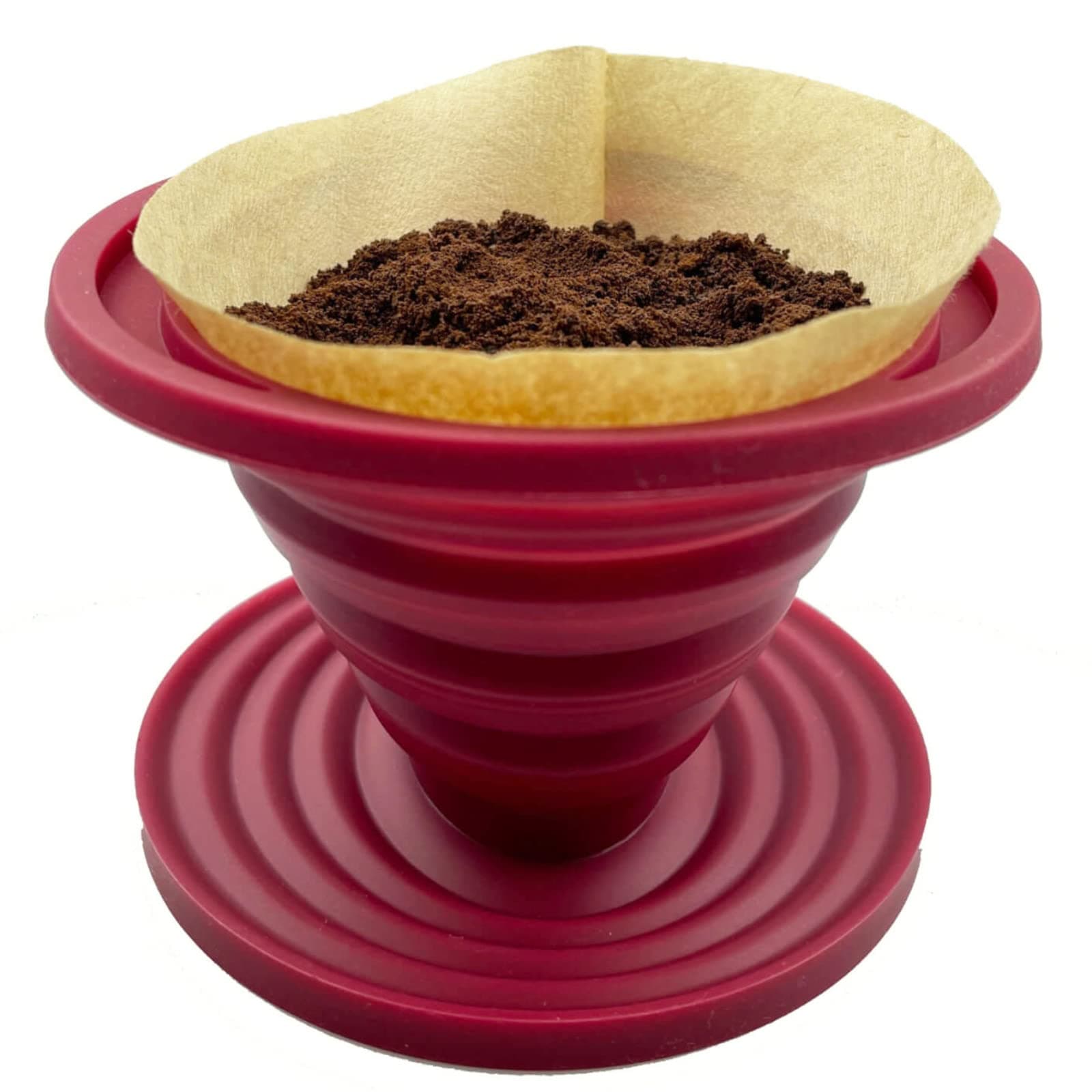
Attsky Collapsible Pour Over Coffee Dripper for Camp Coffee, Reusable Silicone Coffee Filter Holder for Camping Red 1
- EASY TO USE: Make delicious hand brewed coffee anywhere with this pour-over coffee dripper. Available for 1 or 2 people
- PORTABLE: Not only lightweight, but foldable design saves a lot of space, makes storage a breeze and easy to carry
- HEALTHY: This upgraded collapsible coffee dripper is made of high quality food-grade silicone. BPA free. No odor created. Heat resistant up to 464°F

Primula Brew Buddy Portable Pour Over, Reusable Fine Mesh Filter, Dishwasher Safe, Single Serve Coffee or Tea at Any Strength, Ideal for Travel or Camping, Red, 2-Pack Double Pack of 2
- Note: 1)Too coarse a grind, too little coffee, or insufficiently tamping the grounds before brewing can all lead to inadequate pressure for a proper brew. 2)It is important to note that the amount of espresso extracted will vary depending on the grind size and amount and reprogramming may be needed when the size and amount are adjusted
- COFFEE ON THE GO - Anytime, anywhere. Easy and convenient personal brewing system designed for the active coffee lover. The portable, slim line design allows you to brew anywhere you go in as little as 30 seconds. Perfect for everyday use at home, the office, traveling or camping.
- INNOVATIVE DESIGN - Patented brewing technology for a smooth and rich coffee experience. This reusable extra-fine mesh filter ensures no grounds end up in your cup. Fits most coffee cups or mugs including your travel mug.
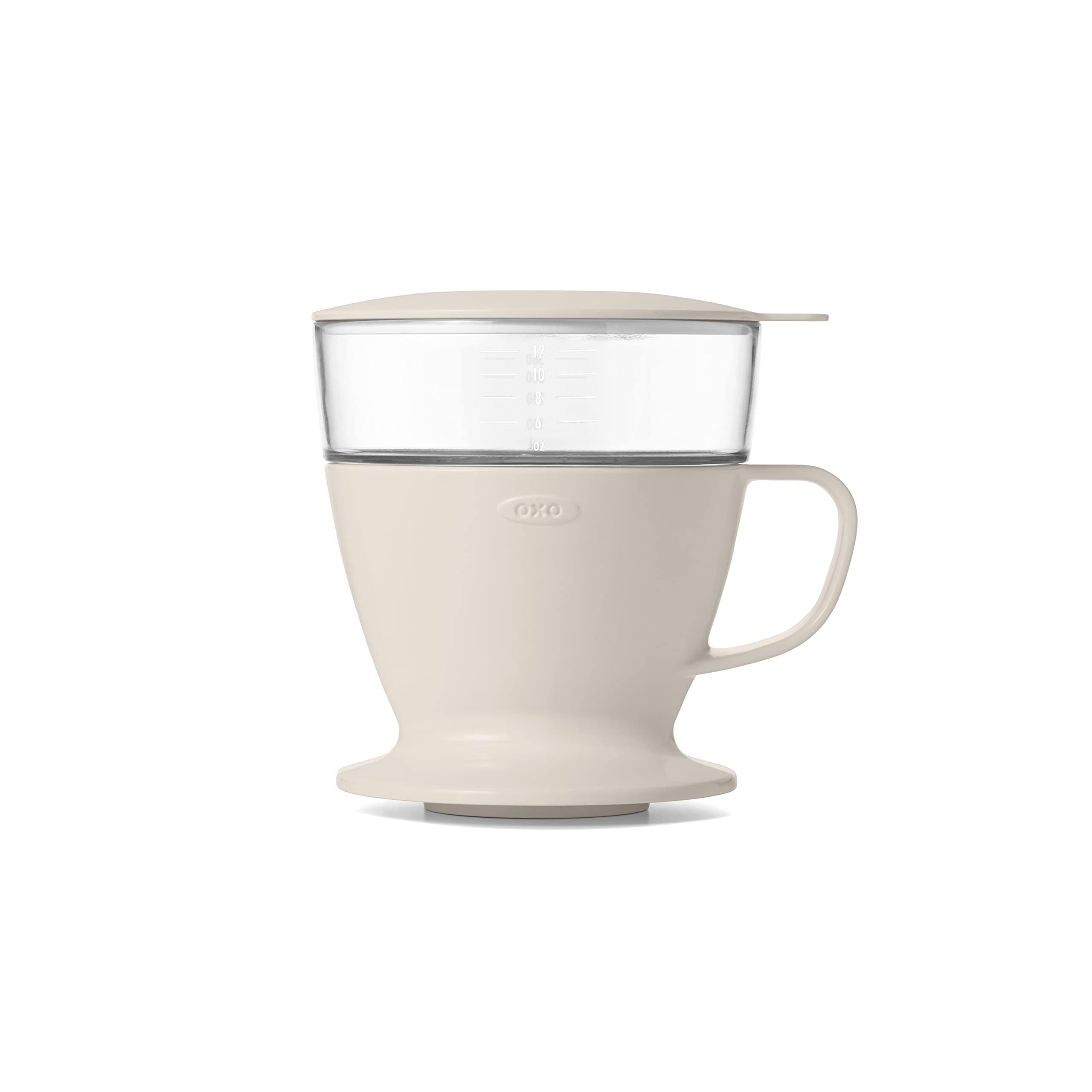
OXO Brew Single Serve Pour-Over Coffee Maker
- Brews consistent, flavorful pour-over coffee with minimal effort
- Auto-drip tank controls water flow for a well-balanced brew
- Measurement markings on Tank show how much water to add, up to 12 ounces

STANLEY Perfect Brew Pour Over Set | 12 oz Camp Mug with Lid Included | Drip Coffee Maker with Reusable Filter | Insulated Stainless Steel | BPA-Free | Black 2.0 Black 2.0 12 oz
- BEST BREW EVERY TIME: Refresh your coffee experience with Stanley products coffee maker! The Stanley Pour Over coffee maker is a traditional way to brew using a Stainless Steel filter. Brew pour over coffee like a pro at home. It is easy to use, and environmentally friendly
- STAINLESS STEEL FILTERS: The stainless steel design is stylish and non-breakable. The stainless steel filter helps extract your coffee's aromatic oils and subtle flavors instead of being absorbed by a paper filter. It’s a smarter option for your coffee. The perfect solution for brewing your fresh brewed coffee at home, in your office, or outdoors
- EASY TO USE: Pour the desired amount of coffee into the filter, place on top of a cup, coffee mug, slowly pour in the hot water, let the coffee maker drip out the water through the fine pour over filter, and remove the coffee dripper when done. Now you are ready to enjoy your drink
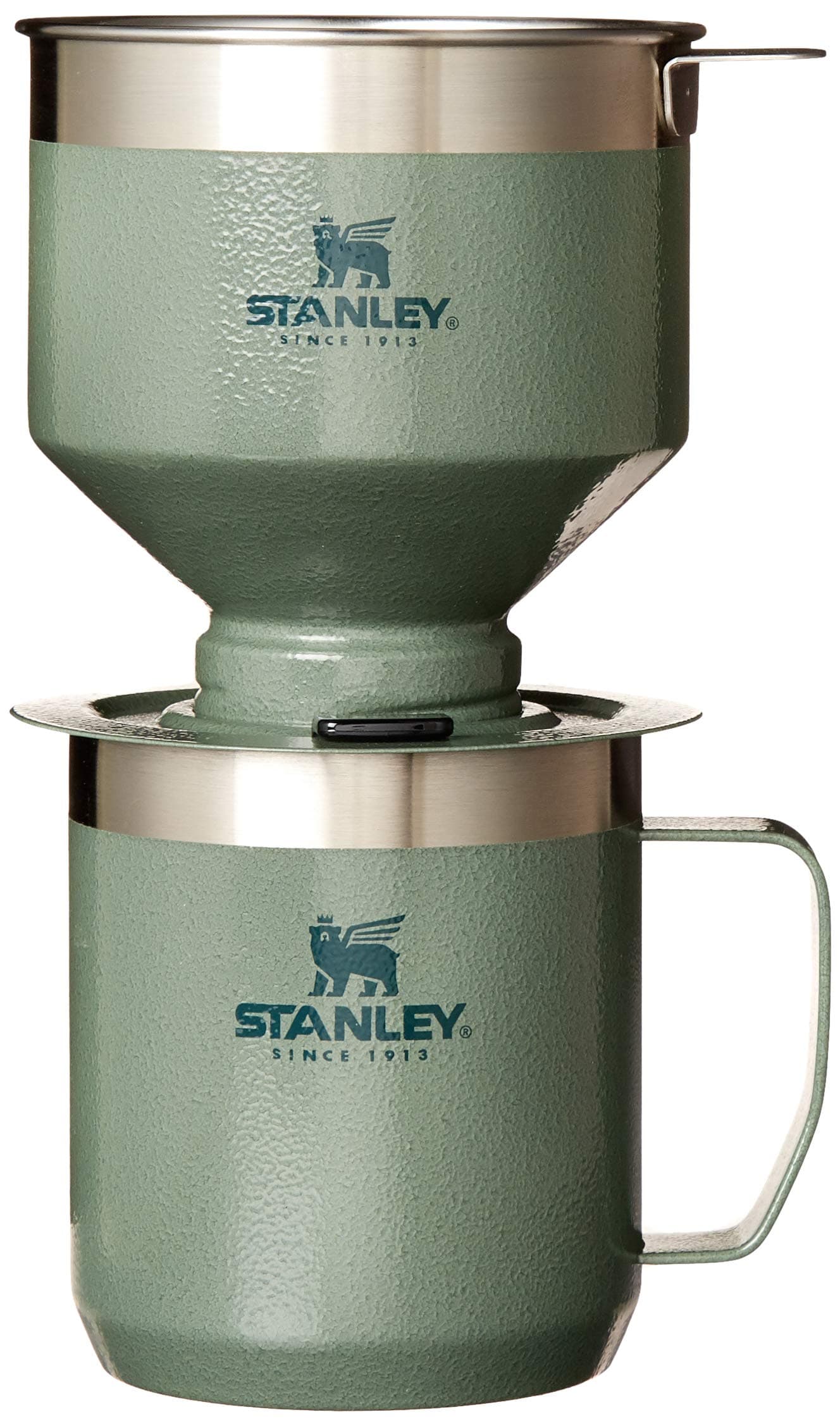
STANLEY Perfect Brew Pour Over Set | 12 oz Camp Mug with Lid Included | Drip Coffee Maker with Reusable Filter | Insulated Stainless Steel | BPA-Free | Hammertone Green Hammertone Green 12 oz
- BEST BREW EVERY TIME: Refresh your coffee experience with Stanley products coffee maker! The Stanley Pour Over coffee maker is a traditional way to brew using a Stainless Steel filter. Brew pour over coffee like a pro at home. It is easy to use, and environmentally friendly
- STAINLESS STEEL FILTERS: The stainless steel design is stylish and non-breakable. The stainless steel filter helps extract your coffee's aromatic oils and subtle flavors instead of being absorbed by a paper filter. It’s a smarter option for your coffee. The perfect solution for brewing your fresh brewed coffee at home, in your office, or outdoors
- EASY TO USE: Pour the desired amount of coffee into the filter, place on top of a cup, coffee mug, slowly pour in the hot water, let the coffee maker drip out the water through the fine pour over filter, and remove the coffee dripper when done. Now you are ready to enjoy your drink
![COLETTI Sierra Camping Pour Over Coffee Dripper — Collapsible Pour Over Coffee Dripper — Includes Pack of Paper Filters [Black, Pack of 1] Pack of 1 Black](/_next/image?url=https%3A%2F%2Fm.media-amazon.com%2Fimages%2FI%2F81W9%2BVau3GL.jpg&w=3840&q=75)
COLETTI Sierra Camping Pour Over Coffee Dripper — Collapsible Pour Over Coffee Dripper — Includes Pack of Paper Filters [Black, Pack of 1] Pack of 1 Black
- BACKPACKING COFFEE POUR OVER — The Sierra pour over coffee maker is an easy to pack collapsible pour over coffee dripper. Designed for a full flavored brew, this pour over dripper will outshine any pack of instant coffee any day. Fit the Sierra in the slimmest of pouches or pockets for your next camping excursion, and … Make Great Coffee Anywhere
- GUARANTEED NON-TOXIC & DISHWASHER SAFE — Safety first and foremost when it comes to brewing with your collapsible coffee pour over. A little secret at COLETTI is that we absolutely love our customers. We expect much of our friends & family to be using our products during their next camping trip. That’s why we guarantee that all our camping coffee makers are safe to the ‘ty’
- SUPERIOR SILICONE COMPOUND — Even though the Sierra is not the only collapsible coffee drip on the market, we took the time to out-engineer our competition by sourcing the best possible silicone available. Our high heat resistant silicone coffee maker doesn’t have any offensive odors, nor is it easily susceptible to punctures
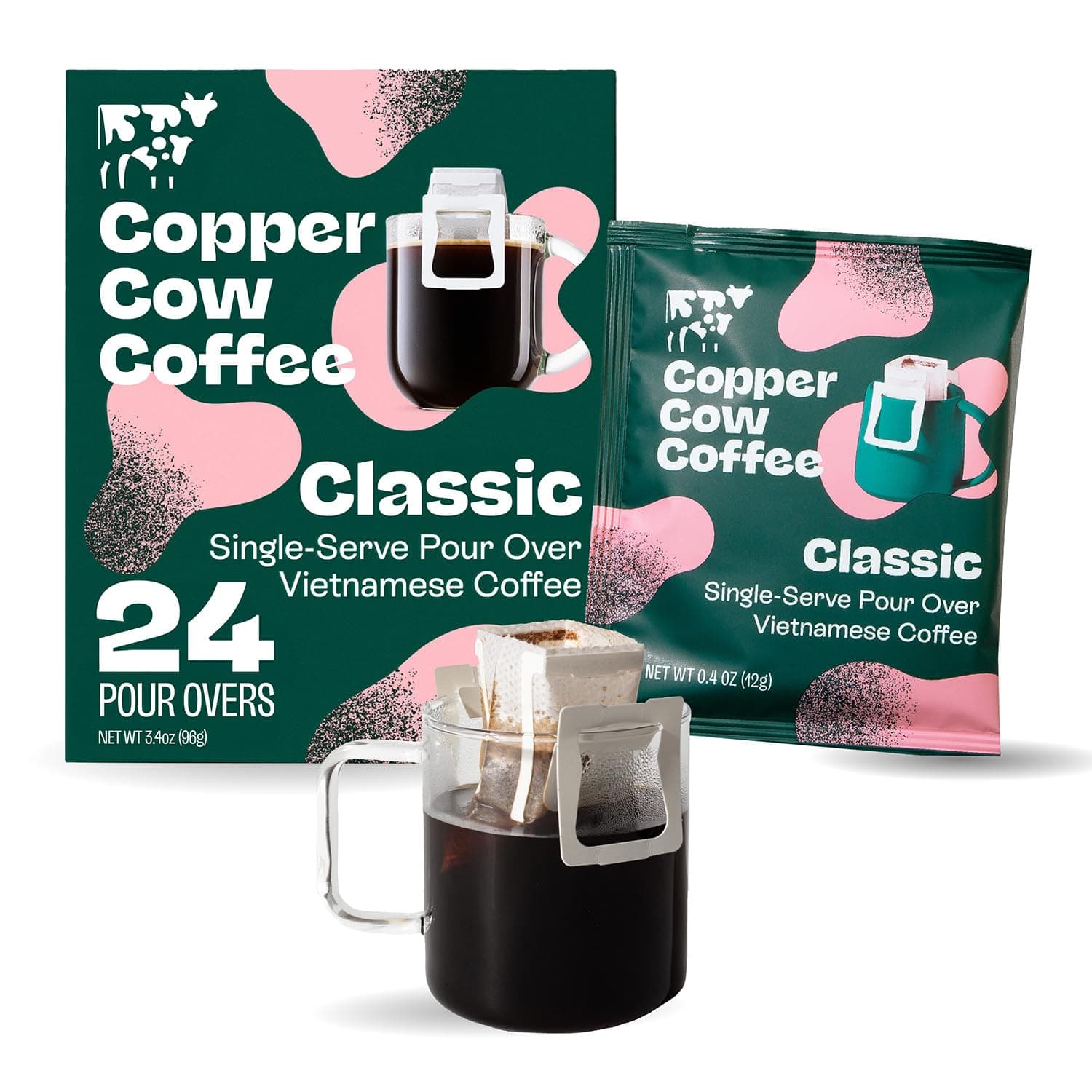
Copper Cow Coffee Premium Pour Over Single-Serve Vietnamese Coffee Pouches (24 pack) | Classic Black | Dark Roast | Convenient Vietnamese Ground Coffee Packets, Travel Friendly Classic Black 0.4 Ounce (Pack of 24)
- WHAT'S INCLUDED – 24 Single-Serve Classic Black Pour-Overs for a rich, effortless cup. Enjoy rich, complex Vietnamese coffee instantly. Pair with our sweetened condensed milk creamers to turn your cup into a perfectly sweetened latte—no brewing equipment or wait time needed.
- EASY TO USE – Four words: tear, hang, pour, enjoy! This coffee puts the “pour” in portable so you can always have good coffee even if you’re not in the kitchen. Just pour hot water into the dripper filter and enjoy!
- SUSTAINABLY SOURCED - We’re woman-founded, pay our Vietnamese farmers 2x market rate, and partner with them to drastically reduce their environmental impact.
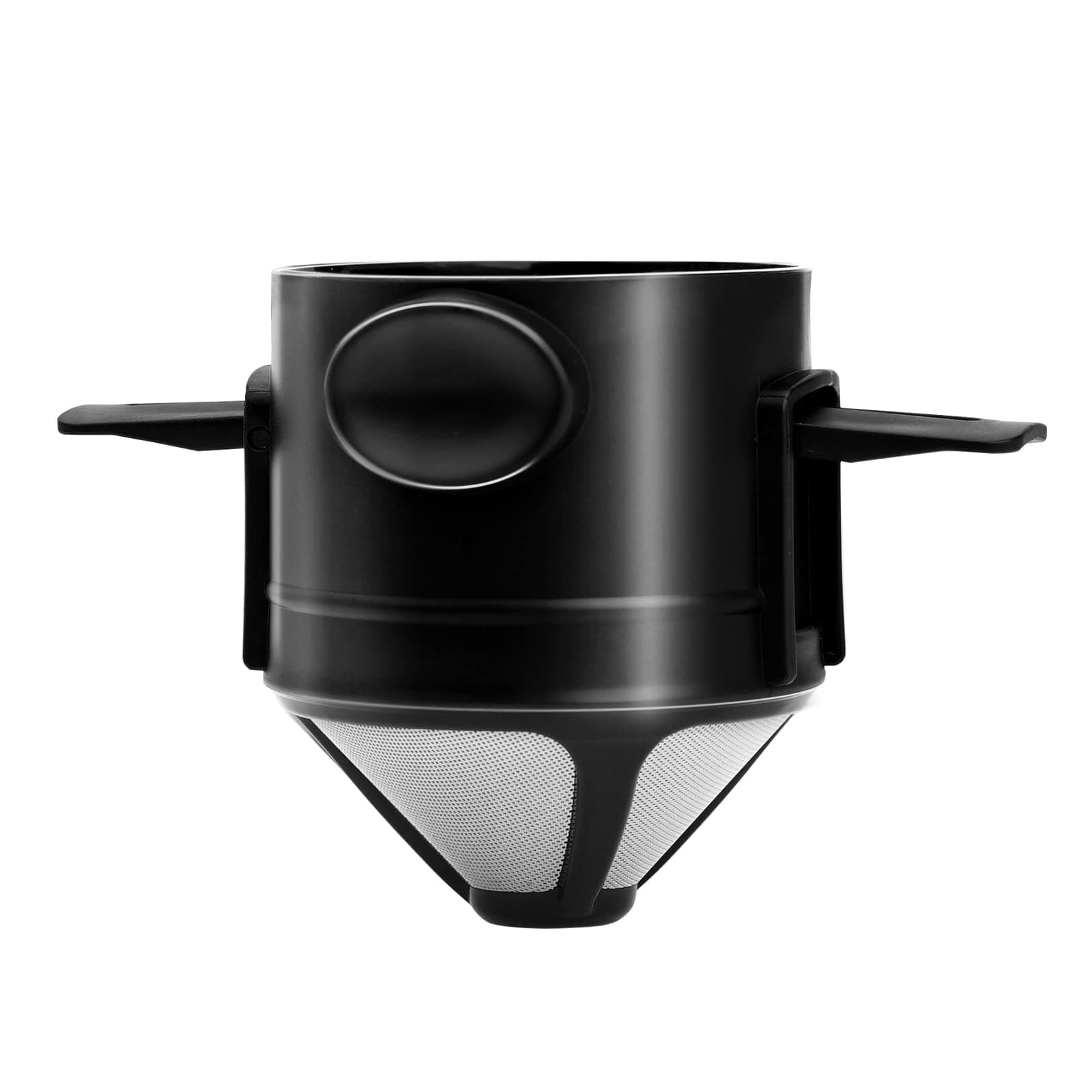
AnnYun Pour Over Coffee Dripper, Reusable Stainless Steel Pour Over Coffee Filters, Easy to Clean Camping Coffee Filter, Portable Collapsible Coffee Maker, Paperless Travel Coffee Makers
- Good Taste: If you like the original flavor of coffee, our pour over coffee dripper use double-layer micro mesh design can make the whole flavor of the coffee powder come out, you just need slowly pour hot water and you will get a cup of fresh hand-brewed coffee. The aroma will fill the house and a wonderful day starts with a delicious cup of coffee.
- Portable Design: Our pour over coffee maker with unique collapsible arm design, high-quality double-layer mesh, easy to carry whether you use it at home, office or even you go camping or traveling. The unfold size of the holder is up to 4.5 inches in diameter, suitable with most of cups, coffee mugs, glasses, etc.
- Eco-friendly: Our paperless coffee filter made of 304 stainless steel and ABS&PP safety material durable and reusable, no more disposable paper filters, it can be washed and reused for many times. By using this reusable coffee filters, you can save money, resources, and the environment, it’s not only good for you, but also for our planet.