
How to Keep Coffee Hot in Cold Weather
Table of Contents
- The Battle Against the Chill: Why Your Coffee Gets Cold
- The Science of Heat Loss in the Wild
- The Essential Pre-Heating Ritual
- Choosing the Right Vessel: Vacuum Insulation vs. The Rest
- Brewing Tactics for Freezing Temperatures
- External Insulation and Pro-Tips
- Common Mistakes to Avoid
- Frequently Asked Questions
There is nothing quite like the silence of a crisp, frost-covered morning at a remote campsite. You’ve done the hard work of grinding your beans by hand and boiling water over a camp stove, but within minutes of pouring that first cup, the biting air turns your liquid gold into a lukewarm disappointment. For the off-grid traveler and nomad, keeping coffee hot isn't just about comfort; it's about preserving the flavor profile of a well-crafted brew and maintaining morale when the thermometer dips below freezing.
In this guide, we are going to dive deep into the mechanics of thermal retention and provide actionable strategies to ensure your coffee stays steaming until the last drop. Whether you are hunkered down in a van during a winter storm or sitting on a granite ledge at sunrise, these techniques will transform your cold-weather brewing experience. We will cover everything from the physics of conduction to the specific gear that outperforms the rest in sub-zero conditions.
The Science of Heat Loss in the Wild
To defeat the cold, you first have to understand how it steals your heat. In an outdoor environment, your coffee loses temperature through three primary methods: conduction, convection, and evaporation. Conduction occurs when your hot coffee touches the cold walls of a mug; the heat energy moves from the liquid to the container. If you set a single-wall metal mug on a frozen rock, the rock will literally suck the heat out of your drink through the bottom of the cup. This is why choosing where you place your coffee is just as important as what you put it in.
Convection is the second culprit, driven by the movement of air. When cold wind blows across the surface of your coffee or the outside of your mug, it carries away the heat. This is why a "wind chill" affects your coffee just as much as it affects your skin. Finally, evaporation is a massive heat sink. As steam rises from an open mug, it carries a significant amount of thermal energy with it. Without a lid, even the most expensive insulated mug will fail to keep your coffee hot for more than twenty minutes in freezing weather.
Understanding these principles allows you to build a defense-in-depth strategy. By addressing each type of heat loss—using lids to stop evaporation, using vacuum insulation to stop conduction, and shielding your cup from the wind to stop convection—you can extend your drinking window from minutes to hours. In the following sections, we will look at how to apply these scientific principles to your daily camp routine using both gear and technique.
The Essential Pre-Heating Ritual
The single most common mistake made by campers is pouring hot coffee into a cold vessel. Most high-quality camp mugs are made of stainless steel, which has a high "thermal mass." If your mug has been sitting in a 30°F (0°C) van all night, the metal is incredibly cold. The moment your 200°F coffee hits that cold steel, the mug acts as a heat sink, instantly dropping the temperature of your coffee by 15 to 20 degrees. You’ve lost the battle before you’ve even taken a sip.
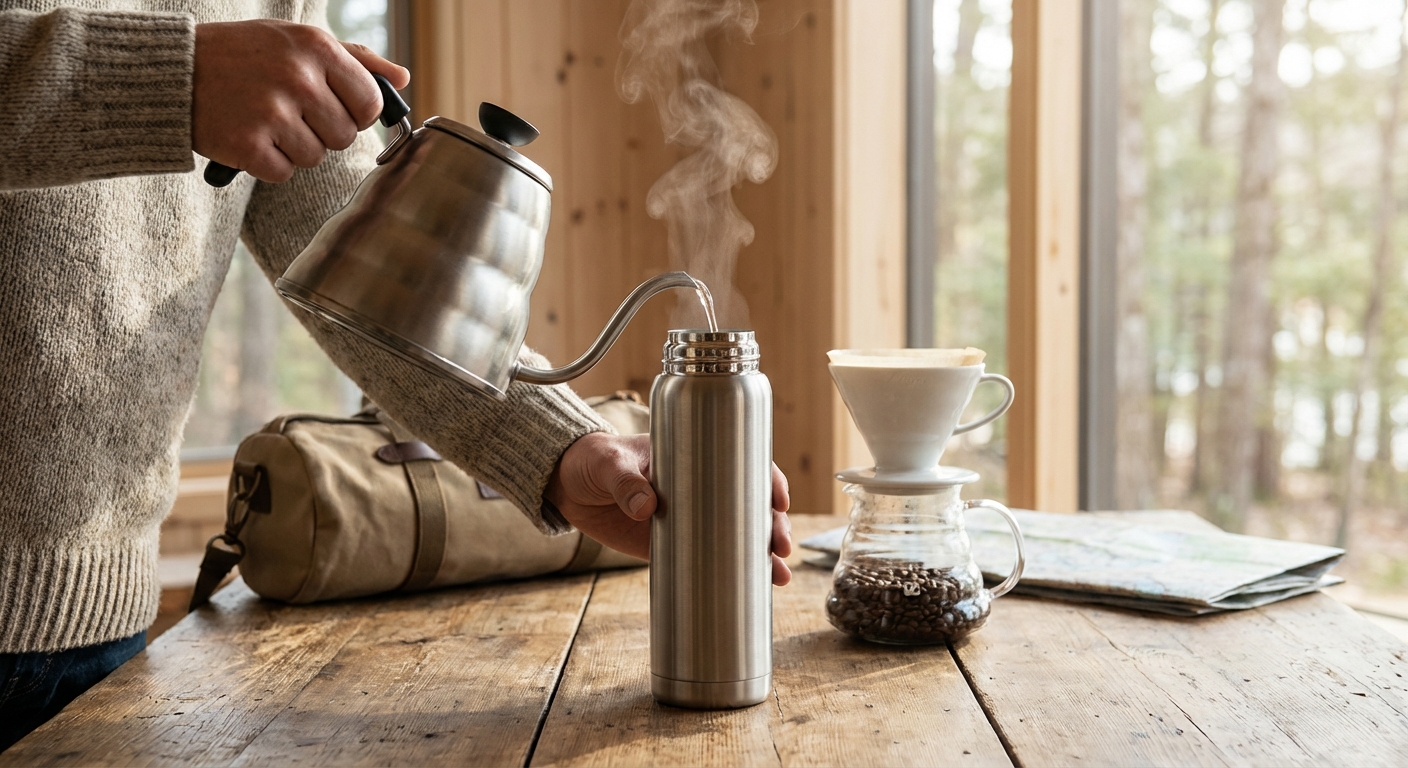
To prevent this, you must incorporate a pre-heating step into your brewing workflow. While you are boiling water for your coffee, boil an extra 8 to 10 ounces. Pour this boiling water into your travel mug or carafe and let it sit for at least two minutes. This raises the temperature of the internal walls of the vessel so that they are no longer "hungry" for the heat from your coffee. When your brew is ready, discard the warming water and immediately pour in your coffee. You will notice a night-and-day difference in how long the beverage stays at an optimal drinking temperature.
This ritual also applies to your brewing equipment. If you are using a glass French press or a ceramic pour-over dripper, these materials will also steal heat during the extraction process. In extreme cold, a cold dripper can lower the brewing temperature so much that it leads to under-extraction, resulting in sour, weak coffee. Always rinse your filters and pre-warm your brewers with hot water. It may seem like a waste of fuel and water, but when you are off-grid, the quality of that one hot cup is worth the extra effort.
Choosing the Right Vessel: Vacuum Insulation vs. The Rest
When it comes to keeping coffee hot camping, the gear you choose is your primary line of defense. The gold standard for off-grid travel is double-wall vacuum insulation. Unlike standard "insulated" mugs that use foam or air, vacuum-sealed vessels have a literal vacuum between two walls of steel. Since a vacuum contains no atoms, heat cannot travel through it via conduction or convection. This creates a nearly impenetrable barrier that keeps the heat inside the inner chamber.
{{PRODUCT_CARD:B07P11Z63H}} The Stanley Classic Legendary Bottle is the quintessential piece of gear for anyone serious about off-grid coffee. We recommend this specifically for basecamp setups or long days on the road where you want to brew a large batch in the morning and have it stay piping hot until the afternoon. It is best for the "NomadBrew" enthusiast who values durability over lightweight minimalism.
The standout feature is the 18/8 stainless steel construction combined with a lid that doubles as an insulated cup. This design ensures that even when you pour a serving, the rest of the contents remain sealed and hot. The vacuum insulation is rated to keep drinks hot for up to 24 hours, though in sub-freezing temperatures, you can realistically expect 12-15 hours of "steaming" heat. The only real drawback is the weight and bulk; it’s not something you’d want to carry on a fast-and-light backpacking trip. Compared to modern "trendy" flasks, the Stanley is more rugged and can survive being dropped on rocks or rattling around in a truck bed without losing its vacuum seal. {{/PRODUCT_CARD}}
For those who prefer to drink directly from their vessel rather than pouring from a flask, a dedicated travel mug with a high-quality seal is necessary. Not all "travel mugs" are created equal. Many have plastic lids that offer zero insulation, allowing heat to escape through the top. Look for mugs with "sip-through" lids that can be fully closed when you aren't drinking.
{{PRODUCT_CARD:B00CHOUI86}} The Zojirushi Stainless Steel Mug is widely considered the "gold standard" for heat retention in the coffee world. We recommend it for solo travelers and van-lifers who want their coffee to stay hot for an entire workday. It is best for those who appreciate precision engineering and need a leak-proof design that can be tossed into a backpack without worry.
The standout feature is the incredibly thin vacuum layer, which makes the mug lighter and more compact than its competitors while providing superior insulation. It features a safety lock to prevent accidental openings and a slick, non-stick interior that is easy to clean even when water is scarce. One drawback is that it actually keeps coffee too hot; you often have to leave the lid off for a few minutes just to make it drinkable. Compared to a standard camp cup, the Zojirushi can keep coffee hot for 6-10 hours, even in a cold vehicle, making it a top-tier choice for the nomad. {{/PRODUCT_CARD}}
Brewing Tactics for Freezing Temperatures
Brewing coffee in the cold requires a different strategy than brewing in a climate-controlled kitchen. The ambient temperature will constantly fight your extraction. To counter this, you should aim for a slightly higher strike temperature (the temperature of the water when it hits the grounds). While 200°F is standard, in sub-freezing weather, you might want to pour right off the boil (212°F) because the water will lose several degrees the moment it leaves the kettle and hits the air.
Speed is also your friend. Methods with long steep times, like a traditional French press, are prone to significant temperature drops during the four-minute wait. If you use a French press, consider wrapping it in a "cozy" (an insulated sleeve) or even a spare wool hat during the brew. Alternatively, switch to a faster method like the AeroPress. Because the AeroPress uses pressure and a finer grind, the total contact time is much shorter, usually around 90 seconds. This leaves less time for the environment to sap the heat from your brew.
Lastly, consider the "surface area to volume" ratio. A tall, narrow vessel will keep coffee hot much longer than a wide, shallow bowl-shaped mug. The more surface area exposed to the air, the faster the heat escapes. When brewing pour-over, use a narrow-mouthed carafe or brew directly into your insulated travel mug. This minimizes the exposure of the coffee to the cold air as it drips, ensuring that the final product starts at the highest possible temperature.
External Insulation and Pro-Tips
If you already have a favorite mug that isn't performing well in the cold, you don't necessarily need to buy new gear. You can augment your current setup with external insulation. For example, many backpackers use "reflectix" (a foil-faced bubble wrap) to create custom cozies for their mugs and dehydrated meal bags. A simple sleeve made of neoprene or even a thick wool sock can provide an extra layer of protection against the wind, significantly extending your coffee's life.
Another pro-tip is to utilize the "internal heater" method. If you are hiking or moving, keep your insulated mug inside your jacket or tucked into a side pocket of your pack that rests against your body. Your body heat will help maintain the temperature of the vessel's exterior, reducing the thermal gradient between the coffee and the outside world. Additionally, always keep your mug on a "coaster" of some sort—a glove, a piece of wood, or a folded cloth—to break the conductive link between the mug and cold surfaces like metal camp tables or frozen ground.
Finally, think about your additives. If you take milk or cream, you are essentially adding a "cold battery" to your hot drink. In the winter, try to pre-warm your milk or cream on the stove before adding it. If that’s too much work, consider switching to powdered creamers or drinking your coffee black during the coldest months. Even a small splash of refrigerated milk can drop your coffee's temperature by 10-15 degrees instantly, which can be the difference between a hot drink and a lukewarm one in ten minutes.
Common Mistakes to Avoid
One of the most frequent errors is "over-stirring." While it’s tempting to stir in your sugar or cream vigorously, every rotation of the spoon introduces cold air into the liquid and increases evaporation. If you must stir, do it quickly and get the lid back on immediately. Every second the lid is off, your coffee is losing heat at an exponential rate. Treat the lid like a vault door—only open it when absolutely necessary.
Another mistake is neglecting the "fill level." A half-empty thermos will lose heat much faster than a full one because the large pocket of air (headspace) inside the bottle will absorb the heat from the liquid. If you aren't going to drink a full liter of coffee, use a smaller 12oz or 16oz flask. By minimizing the air gap, you maximize the thermal efficiency of the container.
Finally, don't rely on "re-heating" on a camp stove if you can avoid it. Re-heating coffee often scorches the oils and destroys the delicate flavor notes you worked so hard to extract. It is far better to invest in the techniques and gear mentioned above to keep the initial heat than to try and claw it back later. Focus on preservation rather than restoration for the best-tasting off-grid experience.
FAQ
Does altitude affect how hot my coffee stays? Yes, but not in the way you might think. At higher altitudes, the boiling point of water is lower (e.g., at 10,000 feet, water boils at about 193°F instead of 212°F). This means your coffee starts at a lower temperature right from the beginning. Additionally, high-altitude air is often thinner and drier, which can accelerate evaporation. To compensate, you must be even more diligent about pre-heating your gear and using a high-quality lid to prevent that precious heat from escaping into the thin mountain air.
Because you are starting with "cooler" boiling water, the margin for error is much smaller. You don't have those extra 10-20 degrees of "buffer" that you have at sea level. This makes vacuum insulation even more critical. If you are camping in the mountains, consider using a brewing method that allows for total immersion, like an AeroPress, which can help maintain a stable temperature during the short extraction period.
Is plastic or stainless steel better for keeping coffee hot? Stainless steel, specifically double-wall vacuum-insulated steel, is vastly superior to plastic. While plastic is a decent insulator compared to single-wall metal, it cannot support a vacuum seal. Most plastic mugs are either double-walled with air in between or filled with foam. Neither of these can compete with the thermal resistance of a vacuum. Furthermore, plastic tends to absorb odors and oils over time, which can ruin the taste of high-quality beans.
However, there is one niche where plastic (specifically BPA-free Tritan or similar) is used: lightweight backpacking. If weight is your absolute priority, a plastic mug with a snug lid is better than a single-wall titanium mug. But for the "NomadBrew" lifestyle where you are likely near a vehicle or basecamp, stainless steel is the undisputed king of heat retention and durability.
How long should I realistically expect my coffee to stay hot outdoors? In freezing conditions (32°F / 0°C), a standard ceramic mug will lose its heat in about 10-15 minutes. A high-quality insulated camp cup with a lid will give you about 30-45 minutes of drinkable warmth. If you use a premium vacuum-sealed flask like a Zojirushi or a Stanley, you can expect your coffee to stay "hot" (above 140°F) for 6 to 12 hours, and "warm" for up to 24 hours, depending on the volume of the container.
Keep in mind that these times decrease every time you open the lid. If you are taking frequent sips, you are introducing cold air and allowing steam to escape, which will significantly shorten the window. For the best results, pour a small amount into a cup and keep the main reservoir tightly sealed.
Can I use a battery-powered mug warmer while camping? While products like the Ember mug exist, they are generally not practical for off-grid or rugged travel. They require significant battery power, which is a precious resource when you are relying on solar or portable power stations. Additionally, they are fragile and not designed for the bumps and drops of camp life. A high-quality vacuum flask is a "passive" technology that requires no power and is far more reliable in the backcountry.
If you have a large power station (like a Jackery or EcoFlow) and are van-camping, you could use a 12V mug warmer, but it’s often more efficient to just store your coffee in a better thermos. The goal of NomadBrew is simplicity and reliability; a good thermos never runs out of battery and won't break if it falls off a tailgate.
Does adding sugar or honey help keep coffee hot? Technically, adding any dissolved solids changes the thermal properties of the liquid slightly, but not enough to make a noticeable difference in heat retention. In fact, the act of stirring in the sugar usually causes more heat loss through convection and evaporation than the sugar could ever prevent. If you like sweeteners, add them to the bottom of the mug before you pour the coffee so they dissolve with minimal stirring.
Interestingly, some people believe that the "fats" in cream can create a thin layer on the surface that reduces evaporation, similar to how oil on water works. While there is a tiny bit of physics to support this, the cold temperature of the cream usually offsets any benefit. If you want the best heat retention, stick to black coffee and keep the lid on tight.
Our Top Picks for 2026
We've spent hours researching and testing to find the absolute best options currently available.

STANLEY Stay-Hot Camp Mug 12 oz | Press Fit Drink Through Lid | Cup for Coffee, Tea and Drinks | Insulated Stainless Steel Coffee Mug | BPA-Free | Black 2.0
- OPTIMAL SIZE, MAXIMUM COMFORT: Enjoy leisurely mornings on your patio with the Stay Hot Camp Mug. Designed to provide legendary Stanley performance, it's just the right fit for cozy moments. Whether it's at home, the office, or a weekend in the great outdoors, this mug delivers
- SIP WITH CONFIDENCE: The secure press-fit Tritan Drink-Thru Lid ensures your sips are splash-free and hassle-free. Not only does it lock in the temperature, but it also prevents those annoying splashes. Sip your beverages easily and confidently, Keep it with you in the backyard, take it on the road, or enjoy it while lounging by the fireside
- THERMAL PERFORMANCE: With Stanley's double-wall vacuum insulation, you can count on your drinks staying at the perfect temperature. Your morning brew will stay hot for up to 1.5 hours. For those craving a cold beverage, it stays cold for 3 hours, and iced for 15 hours

Milton Thermosteel Flip Lid 1000, Double Walled Vacuum Insulated Thermos 1000 ml | 34 oz | 1 Ltr | 24 Hours Hot and Cold Water Bottle with Cover, Stainless Steel, BPA Free,Leak Proof | Silver 34 Ounces
- ✅The included protective jacket may vary in color or design due to mixed inventory. All jackets are high-quality and provide the same insulation and protection.
- ✅ Despite its sizable presence, rest assured that the interior capacity perfectly aligns with the specified title and selected item. The size may seem larger due to it's robust double-wall vacuum insulation.
- ✅ To optimizse Hot & Cold performance precondition the flask with hot or cold water and fill to maximum capacity when using it. Avoid partial filling for maximum effectiveness & secure the lid tightly for keeping temperature locked in.
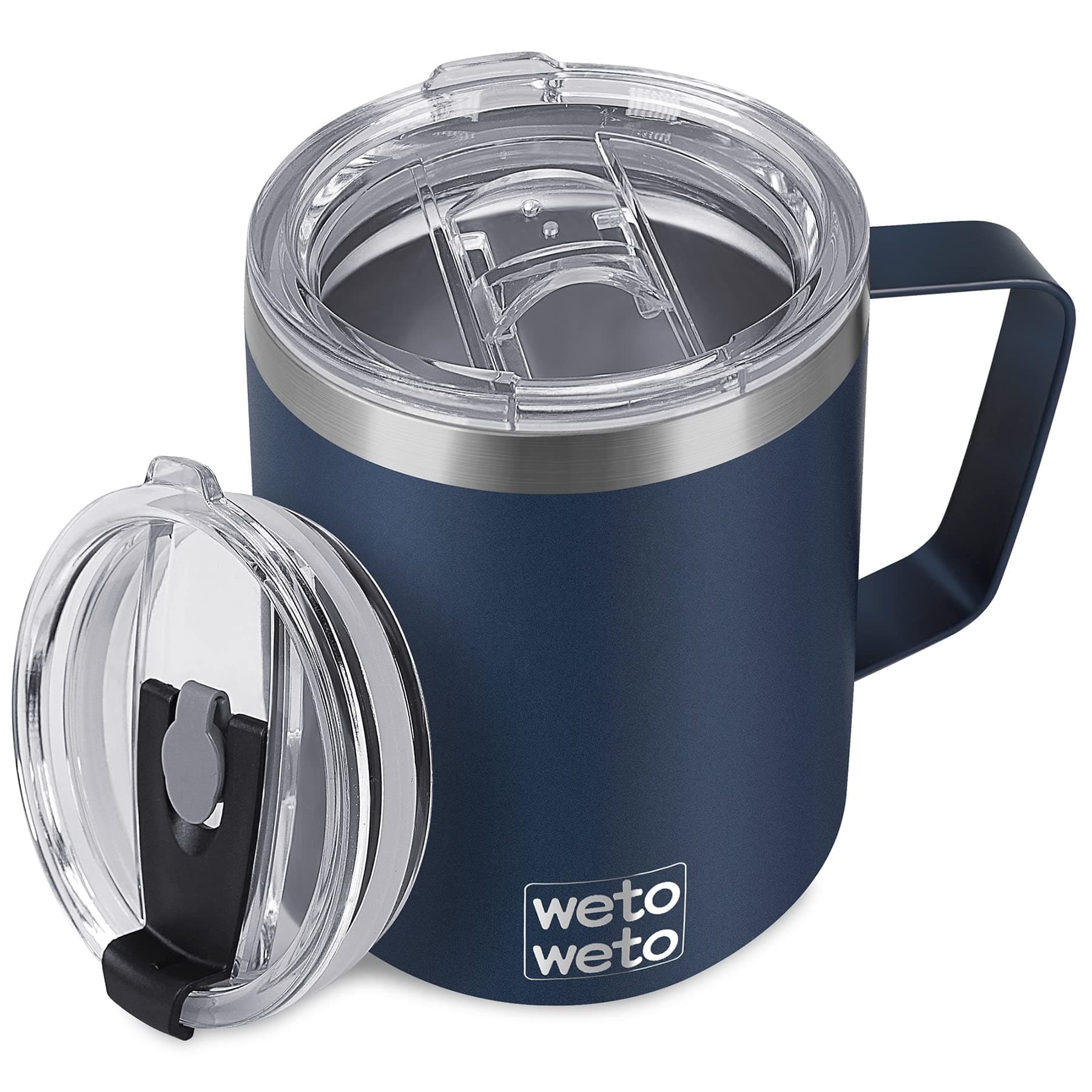
WETOWETO 14 oz Coffee Mug, Vacuum Insulated Camping Mug with Lid, Double Wall Stainless Steel Travel Tumbler Cup, Thermal Coffee Mug, Powder Coated Navy Blue A1-Navy Blue 1 Count (14 oz)
- Vacuum insulated stainless steel construction keeps drinks hot for 4+ hours and cold for 10+ hours
- Comes with flip straw lid for spill-proof sipping and sliding lid for maximum temperature retention
- Powder coated finish resists scratches; made from food-grade 18/8 stainless steel and BPA-free plastic